


Where scholarship meets service
 UC Irvine has long been committed to supporting student veterans’ transitions into
higher education. In addition to on-campus services, in 2019, the campus revamped and expanded its decades-old, one-credit “University Life 101”
course aimed at helping veterans adjust to college life into a full-fledged Veterans Studies Certificate Program. The three-part course sequence – designed with veteran, student, faculty and community
input – is open to both student veterans and non-veteran scholars desiring to develop
a deeper understanding of veterans’ issues and experiences, as well as students aspiring
to careers working with this unique community.
UC Irvine has long been committed to supporting student veterans’ transitions into
higher education. In addition to on-campus services, in 2019, the campus revamped and expanded its decades-old, one-credit “University Life 101”
course aimed at helping veterans adjust to college life into a full-fledged Veterans Studies Certificate Program. The three-part course sequence – designed with veteran, student, faculty and community
input – is open to both student veterans and non-veteran scholars desiring to develop
a deeper understanding of veterans’ issues and experiences, as well as students aspiring
to careers working with this unique community.
Going into its seventh year of operation, the program has enrolled more than 830 students across its curriculum, which includes “Soc Sci 132: Veterans in History and Society,” “Soc Sci 134W: Veterans’ Voices,” and “Soc Sci 133: Veterans’ Transitions.” The program’s courses are taught by veteran or military-connected faculty, fulfill UCI General Education requirements and can be taken individually or as a series. And, perhaps most importantly, the program fills an important workforce and educational gap.
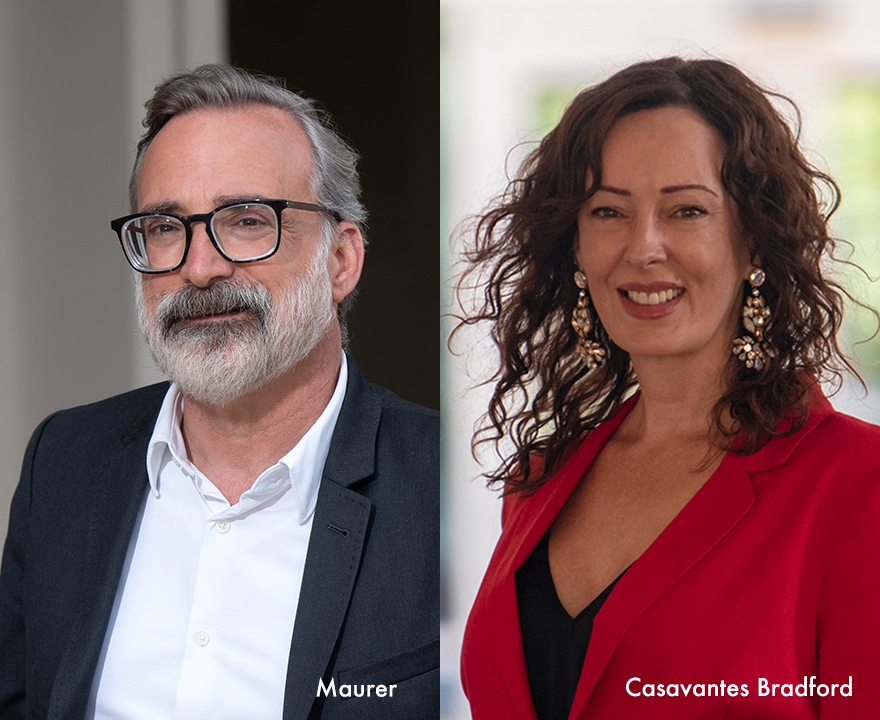
In a new roundtable article for the Journal of Veterans Studies, UCI program founders Bill Maurer, anthropology and law professor and dean of the School of Social Sciences, and Anita Casavantes Bradford, Chicano/Latino studies and history professor, along with colleagues from seven other U.S. colleges and universities reflect on the origins and development of their veterans studies academic programs and initiatives while looking ahead to opportunities and challenges within this relatively new scholarly discipline.
Responses from Maurer and Casavantes Bradford are excerpted below; the full article, “Roundtable: Establishing Veterans Studies as an Academic Discipline,” is available online and free to download.
---
Q: Can you trace the origins and early development of your efforts to establish veterans studies as an academic discipline, noting the challenges you faced or witnessed?
Bill Maurer: At UCI, we had, for a number of years, a course designed specifically for veterans’ transitions. It was intended as a “University Life 101” type of class for our student veterans and was taught for many years by a faculty member who was himself a veteran. We also had several other similar classes aimed at supporting different student populations. However, a few key changes occurred. First, Proposition 209 in California made it more difficult to designate courses for particular student populations; now, every course had to be open to all students. While we adapted to this, our faculty governance body—the academic senate—began reviewing these courses and raised concerns about their academic rigor. They argued that these were more like student support activities rather than academic coursework.
Then, the faculty member who led the veterans’ transitions course retired, creating both a challenge and an opportunity. At that point, Professor Anita Casavantes Bradford and I, in my role as dean, began working together to determine the best way forward. We also consulted with our campus veterans group, which had taken over much of the hands-on mentoring for student veterans. As a result, we realized there was no longer a need for the kind of course previously offered, so we began to consider what could take its place.
Around this time, Anita brought to my attention a workforce need she had heard about from her colleagues and relatives at the VA [Department of Veterans Affairs]. The VA Hospital in Long Beach, just up the road from us, had found their hiring pool very limited. Many potential applicants assumed only veterans could apply for these roles and therefore didn’t pursue them. Anita proposed creating a formal certificate program comprising a sequence of three courses to give both veteran and nonveteran students a broader and deeper understanding of the veteran experience in the United States.
Anita Casavantes Bradford: The program really began because our dean, Bill Maurer—who has long advocated for veterans, both personally and professionally—asked me to review the syllabus for a one-credit course the School of Social Sciences had offered for several decades. This course was designed to help veterans transition to university life.
Recently, our academic senate has become stricter about awarding credit for non-academic work. So, in 2017, as part of his due diligence, Bill asked me to evaluate the class to determine whether it contained sufficient academic content and whether it was a good use of instructional time. He chose me because I was one of the few faculty members who openly identified as military-affiliated and experienced in working with veterans.
When I reviewed the syllabus, I found the course lacking in substantive content. Much of the advice offered for university success was more appropriate for high schoolers who had never worked or been in the real world. I remember thinking that any veteran would, at best, roll their eyes—or, at worst, feel insulted by being told things like “show up on time.” I told Bill the class was not meeting the needs of veteran students and recommended discontinuing it. Instead, I proposed we create one or more courses that would seriously engage with the diversity of veterans’ experiences. If we wanted to support veterans in the academy, we needed to recognize that what they have lived is worthy of study.
Bill was intrigued and suggested we form an exploratory committee on veterans studies. He asked me to gather a group, so I brought in colleagues—veterans from the Army, Navy, and Marine Corps. Bill recruited a VA colleague and veteran students at UCI to discuss what a veterans studies curriculum might cover.
At that time, I was unaware that veterans studies was an established discipline. But after searching academic databases, I discovered JVS. We examined published articles, including Jim Craig’s piece on the emergence of the discipline. Knowing there was already an emerging multidisciplinary intellectual community gave us a valuable foundation for moving forward. We also discussed what both veteran and nonveteran students at UCI might want to learn and sought input from our VA colleague about what knowledge and skills students would need to work effectively with veterans in the future. These conversations led us to focus on three core areas—Veterans in History and Society; Veterans Voices; and Veterans’ Transitions—which became the basis of the three courses in the Veterans Studies Certificate Program.
The next challenge was finding qualified scholars—people with PhDs who were also veterans—to help develop the curriculum. Then we navigated the usual institutional processes: submitting courses to the academic senate for review, ensuring they met university standards, and getting them approved. We brought in a couple of veteran scholars to develop the curricula for two of the courses—Veterans Transitions and Veterans Voices—since they were best qualified for those topics. I developed the curriculum for the original Veterans in History and Society course myself.
At UCI, where academic freedom is valued and broadly interpreted, our goal was to create a template syllabus for each course—a “skeleton” that fulfilled university requirements—while allowing instructors to bring their own expertise and creativity to teaching. One thing that was not a challenge was securing resources for the certificate program. From the beginning, we had the dean’s enthusiastic support. Even as public funding declined, Bill was able to find ways—through small alumni donors who are veterans and by prioritizing the program in the school’s budget—to fund instructor hires and program development.
Bill stands out for his openness to faculty innovation, and UCI, as a whole, fosters an innovative culture. I also tend to be entrepreneurial; when I see a need, I build programs. For colleagues interested in creating veterans studies programs at their institutions—especially if they’re veterans themselves—I recommend approaching this with the same initiative and problem-solving skills learned in military service. Don’t wait for direction—identify what needs to be done, knock on doors, ask questions, and make your case. You’ll find allies and advocates. Even if, at your university, only a single course is possible, one class can make a significant difference in students’ lives.
There have been, and will continue to be, ups and downs in the trajectory of our program. As of 2025, UCI, like many other universities, is grappling with how to withstand extreme budget cuts, and this has meant that, for the time being, we will only be able to offer our Veterans Studies courses during summer session. But as long as Bill and I are around, veterans studies will continue to be important at UCI.
Q: What future changes (e.g., challenges and opportunities) do you anticipate your program in veterans studies and/or the field of veterans studies will face in upcoming years?
Bill Maurer: I won’t be the dean in three years. That’s why all the work we’ve done to promote this program—getting coverage, having people talk about it, and gaining recognition—is so important to ensure its endurance; another real challenge is staffing the courses. We’ve mostly relied on part-time lecturers, which has worked well, but the pool of people truly qualified to teach these courses is small.
As dean, I continually speak to some of my donors to emphasize the importance of this program. It would be wonderful to have a dedicated donor or two specifically for our veterans studies program to help sustain it. I’ve even reached out to organizations like the Defense Council of Credit Unions, with whom I have connections from my own research career. Even so, I remain concerned about the program’s long-term institutional continuity and success.
What I really want is a tenure-line faculty member dedicated to veterans studies but achieving that depends on convincing a department to prioritize such a hire over other competing needs.
Anita Casavantes Bradford: On a more theoretical level, I continue to hope that the field of veteran[s] studies will do more to not only recognize but truly embrace the fact that veterans’ experiences vary significantly depending on their identities and backgrounds. I think that awareness is already present across much of the discipline, but I’d love to see scholars in the field lean further into critical, comparative, and analytical approaches. This isn’t meant as a criticism, but rather as an observation about the way fields evolve. My perspective as a historian is that, for example, Latinx and Chicanx history began in the 1970s by simply documenting the existence of communities—just as women’s history did—and then evolved from there. I look forward to seeing veterans studies similarly develop, with more comparative, relational, and intersectional research. I hesitate to use those terms, because unfortunately, they’ve kind of become buzzwords, which I dislike. But the fact is, all people, veterans included, live their lives within and across a complex range of positionalities and identities.
Things get interesting when, for example, you look at the people I interviewed for my 2021 article in JVS on how Latinx veterans understand service and patriotism–it’s immediately apparent that each of them embodies a wide range of experiences and perspectives. The same is true whether a veteran is white, Black, Brown, Asian; male, female or transgender; citizen or non-citizen; gay or straight; able-bodied or disabled; or a combination of these and other identities. The complexity of veterans’ experiences is what excites me most, and I hope to see more of these nuances uncovered in future research.
Q: Is there anything else you want to say about the idea of the development and maturation of veterans studies as an academic discipline?
Bill Maurer: It’s really helpful for me as dean, when I make arguments for resources, that there are conferences. And there is a journal—having those trappings of discipleship really matter when one is making the case for supporting such a program. Another thing I’ve noticed as I watch this field develop is how the conversation has broadened beyond psychology and social work into film and media studies, literature, history, ethnic studies; this growth is just very interesting in terms of the formation of a discipline.
To learn how you can support this program, please contact Tracy Arcuri, tarcuri@uci.edu.
-Heather Ashbach, UCI School of Social Sciences
-pictured top to right: A flag is raised at UCI's 2024 Veterans Day program on campus;
courtesy of Steve Zylius, UCI. Bill Maurer and Anita Casavantes Bradford; courtesy
of Zylius and Luis Fonseca, UCI School of Social Sciences.