


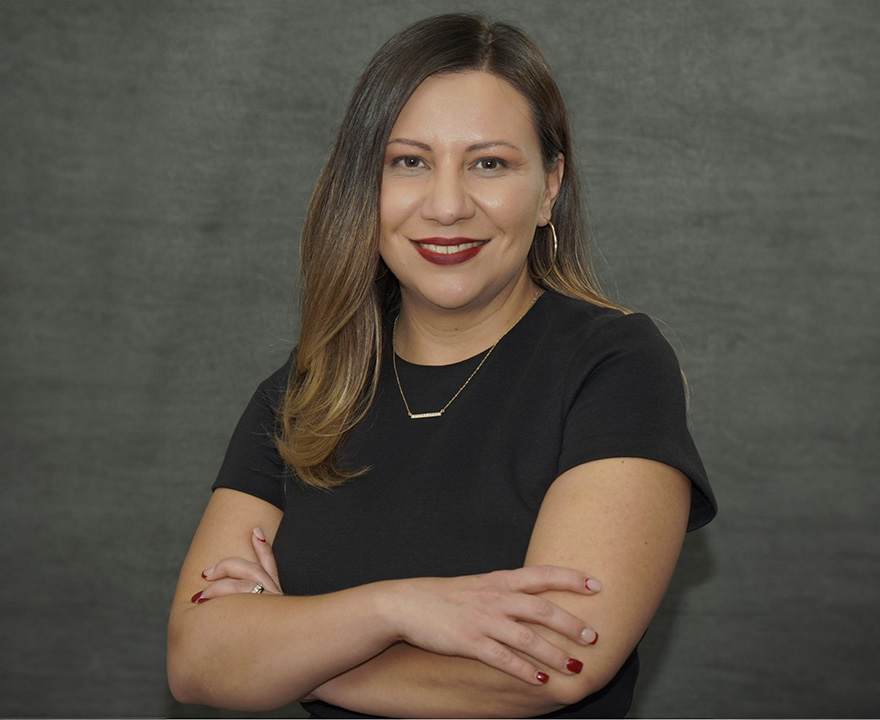
Housing the public good
“There’s only one thing that solves homelessness, and that’s housing,” says Deyanira Nevarez Martinez.
The UC Irvine alumna who earned her Ph.D. in urban and environmental planning and policy with an emphasis in Chicano/Latino studies in 2021 has spent much of her life studying the complicated systems that make housing difficult to secure in the first place. As an assistant professor at Michigan State University and a member of the Lansing City Council, Nevarez Martinez approaches housing as more than a policy issue. Instead, she views it as a foundation for civic participation, public health and community stability.
Her perspective is grounded as much in lived experience as it is in academic training. Her parents were migrant farmworkers and the family moved between California and Arizona. Nevarez Martinez grew up moving with the agricultural seasons, navigating unstable schooling and witnessing the realities of housing insecurity long before she had the language of urban planning to describe it.
Today, she studies homelessness and farmworker housing while helping shape policy in Lansing, Michigan, where she is one of four Chicanos serving on an eight-member city council in a city that is only about 13 percent Latino. For Nevarez Martinez, housing policy has never been just about buildings or zoning codes. It is about the lived realities of the people those systems affect.
“At a very young age, I realized there was a privilege that came with citizenship and being able to say things other people maybe wanted to say but couldn’t,” she says. “If there is a space where I can do some good, I’m going to get involved.”
Learning how systems shape lives
Nevarez Martinez spent her childhood between San Luis, Arizona, on the U.S.-Mexico border and Gilroy, California, known as the “garlic capital of the world.” Her family lived in a colonia, an informal settlement common along the U.S.-Mexico border, where basic infrastructure such as running water and paved roads was not always guaranteed. Until she was about 12 years old, the family migrated seasonally between the two communities. The movement shaped many aspects of her early life, especially her education.
She attended a different California school every year. Groups of migrant students often moved through school systems together, relocated from campus to campus depending on available resources and district decisions. Some children stayed mostly within their own circles, reluctant to form new friendships they would soon have to leave behind. Nevarez Martinez reacted differently.
“I think I had kind of the opposite reaction,” she says. “I wanted to meet as many people as possible because I knew I might only be there for a month.”
At home, education was understood as a pathway to a different kind of future. Nevarez Martinez remembers making a deal with her parents: if she earned good grades, she would not have to work in the fields. Her older brother occasionally joined their parents at work and would come home exhausted and sick after long days that started before dawn. His experience left a big impression.
“I took it so seriously I got a Ph.D.,” she says with a laugh.
But education represented more than economic mobility. It also became a way to better understand the systems shaping the communities around her. After earning a bachelor’s degree in political science at the University of Arizona, Nevarez Martinez worked in Arizona politics, including for Congressman Raúl Grijalva and later with organizations focused on civic engagement in Latino communities.
One experience, in particular, changed the trajectory of her career. While organizing voter outreach with Mi Familia Vota, canvassing teams repeatedly encountered neighborhoods that were physically difficult to access. Some were separated by freeways without pedestrian crossings. Others lacked sidewalks or flooded during storms. The obstacles revealed something she had not heard discussed in conversations about civic participation.
“We often think about barriers to civic engagement in sociological terms, like race, gender and class,” she says. “But we don’t think as much about the physical barriers to civic engagement.”
She began thinking about questions that urban planners confront every day: whether residents could safely walk to polling places, whether public transportation routes connected communities to essential services and who made decisions about sidewalks and infrastructure in the first place. Those questions led her toward studying urban planning.
Finding an intellectual home at UC Irvine
When Nevarez Martinez decided to pursue a Ph.D., she knew she wanted an academic environment where urban planning and Chicano/Latino studies could meaningfully intersect. That combination was rare.
After reaching out to pioneering Chicano studies scholar Rudy Acuña for guidance, she was directed to UC Irvine professor Rudy Torres, whose work connected both fields. The conversation eventually led Nevarez Martinez to UC Irvine, where she earned a Ph.D. in urban and environmental planning and policy in 2021, along with a concentration in Chicano/Latino studies.
Nevarez Martinez entered graduate school without initially envisioning a career in academia. Her training in urban planning was geared more toward practice than research, and for years she imagined herself working primarily as a planner.
“When I finished undergrad, I thought, ‘Thank God that’s over. I’m never doing that again,’” she says with a laugh. “Then four years later, I was getting a master’s degree. After my planning degree, I thought I was going to become a practicing planner. And then I ended up right back in school getting a Ph.D.”
What kept drawing her back, she says, was curiosity and the belief that education could amplify her ability to advocate for communities often excluded from policy conversations.
“Plus, I’m a lifelong learner,” she says.
At UC Irvine, that curiosity found a home. In addition to her work in the urban planning and public policy department, Nevarez Martinez found an important intellectual community through the university’s Chicano/Latino studies program, where students across disciplines grappled with questions of race, inequality and community life. Faculty members including Torres, Maria Rendón, Laura Enriquez and Belinda Campos became important mentors, helping shape the way she approached scholarship, teaching and community-engaged research.
UC Irvine also gave her something she now recognizes as especially important: representation. Nevarez Martinez is currently the only Latina in the School of Planning, Design and Construction at Michigan State University. If she earns tenure next year, she will become the first Latina to do so in the school’s history. The contrast has deepened her appreciation for the mentorship and visibility she experienced at UC Irvine.
“In Irvine, I had the benefit of seeing people like my advisors,” she says. “Those role models don’t exist in all places.”
Housing as public service
Nevarez Martinez originally planned to study informal settlements along the U.S.-Mexico border for her dissertation, drawing in part from her own experiences growing up in a colonia. But the COVID-19 pandemic forced her research in a different direction.
After receiving approval for fieldwork in February 2020, university shutdowns and travel restrictions made it impossible to continue the multi-site ethnography she had designed. Instead, she focused her dissertation on homelessness in Orange County, conducting research while also helping run a meal program for unhoused residents through the nonprofit Housing Is a Human Right OC. Her resulting dissertation became one of the few recent academic studies focused specifically on homelessness in Orange County, an issue often overshadowed by attention on Los Angeles and the Bay Area in this state.
On the Lansing City Council, Nevarez Martinez has worked on housing initiatives that include a modular transitional housing community for unhoused residents and policies designed to encourage affordable housing development. Her urban planning background gives her fluency in the technical language of zoning, land use and development incentives, the policies that shape everyday life in cities. But she also approaches those policies through the lens of someone who understands housing instability firsthand.
The child of farmworkers who once moved between migrant camps is now leading a major state-funded study on farmworker housing in Michigan. Supported by an $800,000 grant, the project examines the housing, labor and economic conditions of migrant and seasonal farmworkers across the state. The project connects directly to the communities that shaped her own childhood.
Nevarez Martinez also sees mentorship as part of that work. She serves as a faculty advisor to several student organizations, including groups supporting Latino students and students of color. She hopes students who see her “walking the halls” recognize that there is space for them in academia and public life too. She hopes representation shapes what students believe is possible.
The child who negotiated her way out of the fields by promising good grades has kept that promise many times over. Now she is negotiating something larger: what it looks like to build cities that leave fewer people behind.
-Jill Kato for UC Irvine School of Social Sciences
-pictured: Deyanira Nevarez Martinez