


The questions beneath the equations
 When scientists develop a theory, what exactly have they discovered? When two theories
appear different but make the same predictions, are they describing the same reality?
And when physicists claim to understand the world, what kind of understanding have
they achieved?
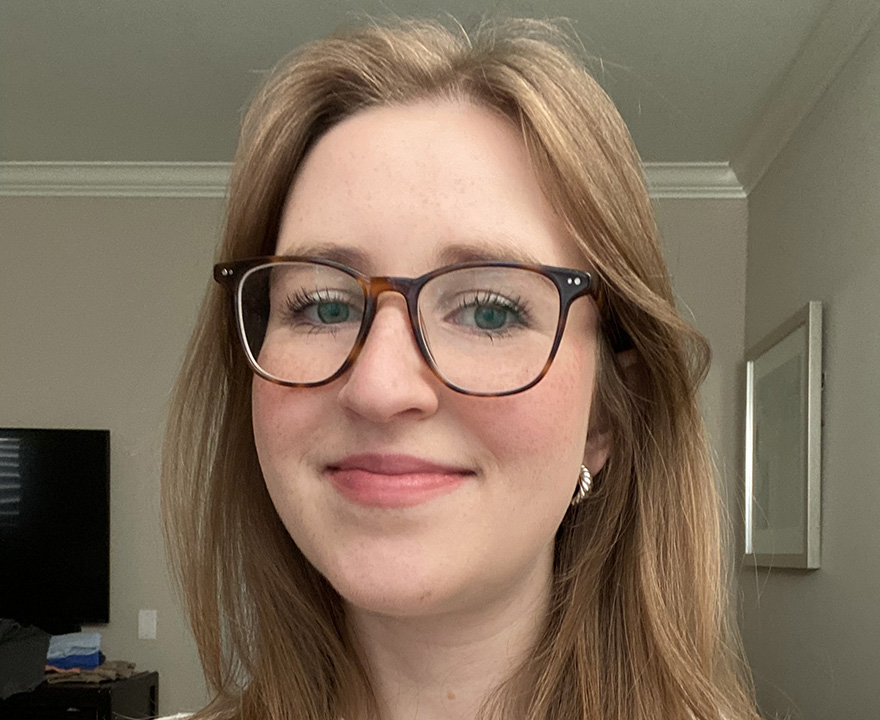
These are the kinds of questions that occupy Clara Bradley, a philosopher of science whose research sits at the intersection of physics, mathematics and philosophy. They are also the questions that first captured her imagination as a teenager and eventually led her from England to UC Irvine, home to one of the world’s top five programs in both philosophy of physics and mathematics before joining the faculty at University College London.
To understand Bradley's work, it helps to understand the discipline she chose to pursue. For most people, philosophy and physics seem worlds apart. One discipline brings to mind images of laboratories and equations; the other, abstract debates about knowledge and truth. Bradley's work exists where those worlds meet.
"Philosophy of science seeks to understand how science works, why scientific knowledge is trustworthy and how scientific practice can be improved," she says.
The field steps back from scientific discoveries themselves to examine the processes that produce them. It asks how theories are developed, how evidence functions and what scientists mean when they claim to know something about the world. Yet these questions touch on how human beings make sense of reality. For Bradley, they have been a lifelong fascination.
An obsession begins
Bradley was born in Paris and raised in London. An academic life was always something she was aware of. Her grandfather was a chemist, and her father a philosopher. Intellectual work was something she understood from an early age not simply as a profession, but as a way of engaging with the world. When she began picking up books about physics and philosophy, the problems she encountered seemed inexhaustible, and she found herself returning to them.
"I had this obsession with the subject that started when I was 16," Bradley says. "All I wanted to do was read about it and pursue it. The world of theoretical physics was just so fascinating. I really enjoyed puzzling my way through things, trying to understand difficult concepts and conceptualize things that were quite abstract."
Part of the inspiration came from a high school teacher who introduced her to the writings of physicist Richard Feynman. His books offered a glimpse into the ways scientists think about problems, building theories that attempt to explain everything from subatomic particles to the structure of the cosmos. The deeper Bradley ventured into physics, the more she found herself drawn to the conceptual foundations beneath it. The questions of physics naturally led to questions of philosophy.
As an undergraduate at the University of Bristol, Bradley pursued both disciplines, earning an MSci in physics and philosophy. Rather than choosing between them, she discovered that each enriched the other. Physics provided powerful explanations of the natural world. Philosophy offered tools for interpreting what those explanations meant. Together, they gave Bradley a way to pursue the intellectual puzzles that had occupied her since adolescence.
Finding an intellectual home
Bradley’s path to UC Irvine began thousands of miles away, at a summer school in Munich. As a first-year undergraduate, Bradley attended a program for women in mathematical philosophy. One of the instructors was James Weatherall, a professor in UC Irvine's Department of Logic and Philosophy of Science whose work she had already begun reading.
"I was super excited to meet him," she says.
What began as a brief encounter would become one of the most consequential relationships of Bradley's academic life. Weatherall recognized both Bradley's enthusiasm and her talent, and after the summer program ended, their conversations continued. He read her work, discussed ideas with her and helped introduce her to a field that few undergraduates encounter in depth. Over time, the relationship evolved into an informal mentorship. By the time she began applying to doctoral programs, Bradley's priorities were clear.
"I had never heard of Irvine as a place or a university," she says. "All I knew is that I wanted to work with Jim."
What drew her across the Atlantic was initially one person. What kept her there was an intellectual community. The Department of Logic and Philosophy of Science is among the world’s top-ranked programs, with nine subfields ranked in the top five. It brings together students who approach philosophy through their interests in science, mathematics and problem-solving. For Bradley, who had spent years pursuing a relatively niche set of interests, the experience was revelatory.
"I couldn't believe how many like-minded people there were," she says.
Over the years, Bradley developed close friendships with fellow students and became part of a community that remained intellectually engaged long after seminars ended.
"I became extremely close friends with so many people as a result of it," she says.
Those relationships were one part of what made the program distinctive. Mentorship was another.
"Jim has been the central part of my life since I was 18 years old," Bradley says. "He's been that person who's always pushed me to be the best person possible, always supported me, but in a way that let me become my own person."
That support often took practical forms. Before conference presentations, Bradley would give practice talks. Before entering the academic job market, she participated in mock interviews with faculty members who offered feedback and guidance.
"Every time I gave a talk, Jim would let me give him a practice talk," she says. "Before I did my job interviews I did a practice interview with the department."
That kind of support was built into the program itself.
"It was always very clear throughout the program what you should be doing at each stage and how they can support you," Bradley says.
What counts as the same thing?
At the center of Bradley's doctoral research was a question: How do we know when two theories are really saying the same thing? Physicists sometimes develop multiple ways of expressing a single theory. The mathematical formulations can look quite different, even when scientists believe they describe the same phenomenon.
"I was looking at particular cases in physics where physicists talk about there being lots of different ways of formulating one theory," Bradley says. "It's almost like two different languages for describing the same thing."
Physicists often assume that different formulations are interchangeable. Bradley wanted to understand what justifies that assumption and whether it always holds. The problem sits within philosophy of science. It is not primarily about producing new physical theories. It is about understanding what existing theories mean and how scientists should interpret them.
The question may sound esoteric, but it touches on a broader challenge that runs throughout scientific inquiry. Scientific theories do not arrive neatly labeled with instructions explaining what they reveal about reality. Scientists and philosophers alike must determine how to interpret them. Bradley's work sought to develop clearer ways of comparing theories and understanding what they tell us about the world.
For Bradley, careful thinking often begins by slowing down. Before asking whether a problem can be solved, she wants to know whether it has been framed correctly in the first place. The deepest challenges are not always the result of missing information. Sometimes they emerge from the struggle to make sense of what we already know.
The big puzzles
In academia, landing a permanent faculty position can be a long and uncertain process. As Bradley neared the end of her doctoral studies, she decided to test the market cautiously by going out "softly" on the job market. Then a position opened at University College London.
"I saw the posting and thought, 'I would love to be in London. UCL is an amazing department with amazing people. I'd love to work there,'" Bradley says. "The stars aligned. I ended up getting the job by December, and in the end, it turned out to be the only job that I applied for."
Today, Bradley continues to build on ideas that first emerged during her doctoral research. Her work focuses on foundational questions in physics, including puzzles that arise from one of the discipline's most famous unresolved challenges. General relativity explains gravity and the large-scale structure of the universe, while quantum mechanics describes the microscopic world of particles and fields. Both work remarkably well, but they do not necessarily fit together easily. The conceptual puzzles surrounding those theories are precisely the kinds of questions that attract her.
"I like to think that what I'm trying to do at the moment is make my mark on some of the big puzzles that are in physics right now," she says.
She hopes philosophical analysis can also help scientists think more clearly about their own work. If philosophers can clarify assumptions, identify conceptual confusion or reveal hidden possibilities, they may help shape the future direction of scientific inquiry itself.
The questions have grown more complex. The mathematics has become more sophisticated. But her underlying curiosity remains unchanged. The universe still presents plenty of mysteries. And Clara Bradley is still asking what it means to understand them.
-Jill Kato for UC Irvine School of Social Sciences
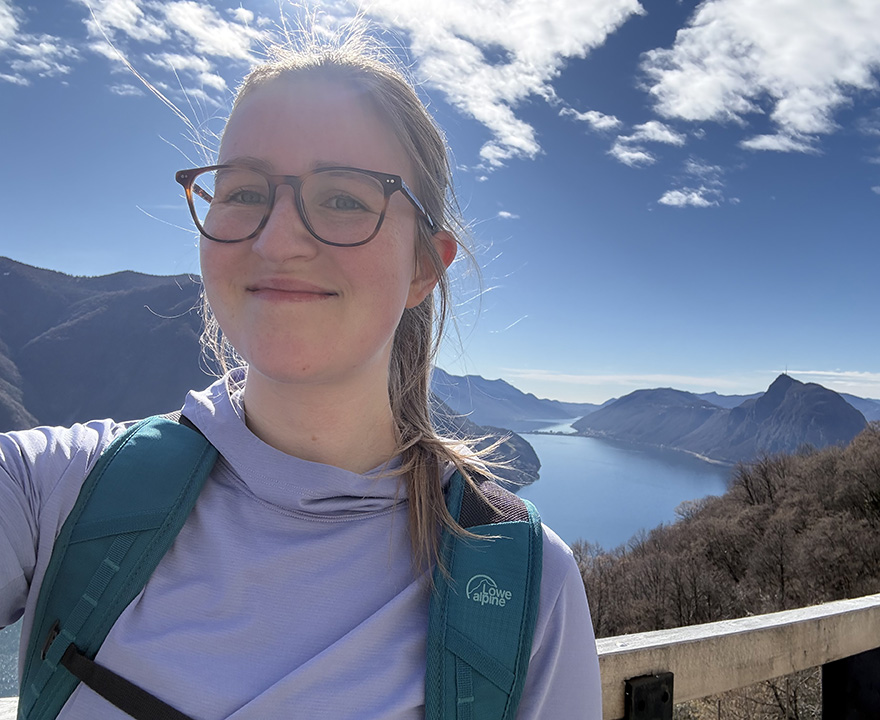
-pictured: Clara Bradley. Bradley hiking in Lugano, Switzerland.