


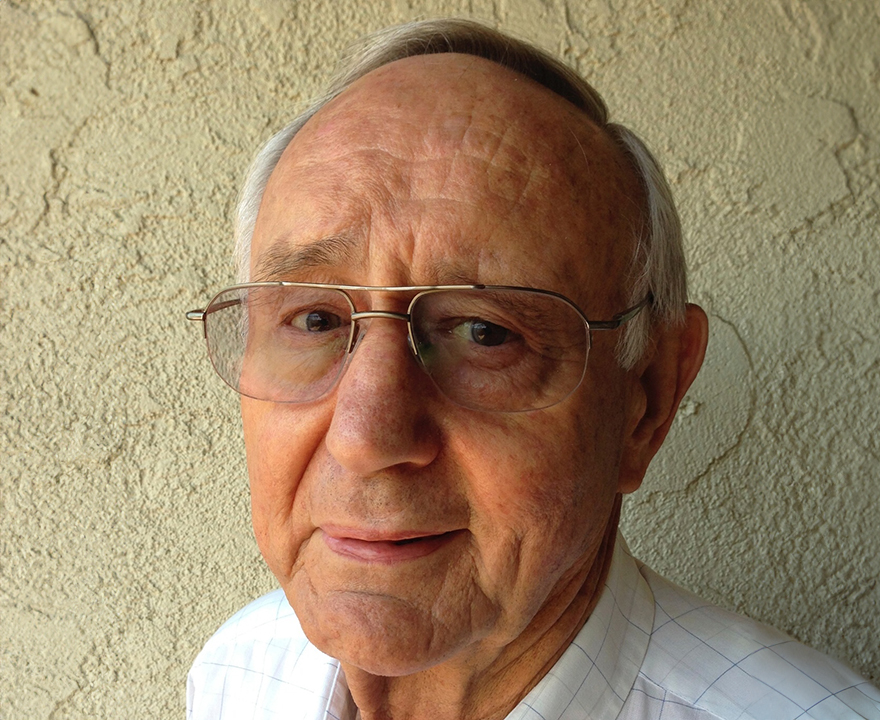
In memoriam: Gordon J. “Pete” Fielding
Gordon J. “Pete” Fielding, UC Irvine economics professor emeritus, passed away on Nov. 21, 2025, at the age of 91.
One of UCI's founding faculty members, Fielding was an internationally recognized researcher who pursued work on transportation planning and the use of variable pricing to influence transportation usage, driving patterns, and parking needs which continues to be highly influential in transportation and government fields today. His more than 30-year career as a professor yielded nearly 100 academic articles, three books and multiple state and federal advisory board appointments. His early publications explored how geography and agriculture shape each other and how politics and social factors influence where economic activity becomes located, while his most recent research focused on congestion pricing and the management of toll roads in Southern California.
"As an academic, Pete contributed important, grounded research on various topics in transportation, including congestion pricing, measuring the efficiency of alternative modes of transit, and toll roads," says longtime colleague and friend Jim Danziger, UCI political science professor emeritus. "He applied his knowledge through his extensive direct engagement with the Orange County Transportation Authority on such decisions as the bus system and the establishment of the county’s toll roads.”
His findings were also featured widely in trade publications and prestigious journals including, most recently, the Journal of Transport Geography and the Journal of Transport Economics and Policy.
Fielding was a member of the Transportation Research Board within the National Academies of Sciences, Engineering, and Medicine, a member of the Association of American Geographers, and former director of the UCI Institute of Transportation Studies, a program he applauded for “putting UCI on the map for transportation engineering and transportation economics,” he said in an interview in 1989 with Samuel McCulloch for the Oral Histories Project.
Born and raised in New Zealand, Fielding excelled at rugby and was the first member of his extended family to go to college, earning bachelor’s and master’s degrees at the University of Auckland. In 1958, he came to the United States on a Fulbright Scholarship to pursue graduate studies at UCLA. He soon became captain of the Bruins rugby team, met and married his wife Kathleen, and completed his Ph.D. in geography (1962). The couple moved back to New Zealand to start a family, teaching at the University of Auckland until the opening of a new UC campus brought the opportunity of a lifetime.
Fielding arrived at UC Irvine in 1965 as an assistant professor of geography and one of the campus’s original faculty members. That year, he taught “Social Science 1: Introduction to Social Sciences” with several founding faculty before shifting the next year to the introductory sequences in both geography and urban studies.
Fielding was tapped in UCI’s early years by founding Chancellor Dan Aldrich and others to join the collaborative Project 21 which brought together leading community members and faculty to consider issues for the 21st century. He was part of two programs that would prove pivotal for the future of Orange County’s open spaces and transportation systems. The first - his group on open space - made the decision to merge the harbor and parks departments to free up funding that enabled them to purchase and preserve open space that is now Featherly Park in Anaheim, Mile Square Park in Fountain Valley, Caspers Park off Ortega Highway, and others. In his interview with McCulloch, Fielding noted how proud he was of the significant contributions this group made for the future of Orange County.
His other group focused on transportation, recognizing early on the need for a transit district while trying to address the urban planning question of whether to provide a new freeway or a new rail line between central Los Angeles and Long Beach Harbor.
Fielding began by working with local community groups in Compton, driving there for afternoon meetings over the course of five weeks, his family explains: “He found that his Māori heritage helped him build bridges, especially within the Pacific Islander and Black communities, where elder matriarchs were the most influential organizers. He was welcomed into their homes and listened to their concerns, seeking their advice on transportation preferences. They expressed a clear preference for rail lines over more freeways because that would allow for greater transportation options, especially for those who did not have access to personal vehicles. Expanded rail lines would lead to increased job opportunities as well, with easier access to East Los Angeles and higher-paying jobs at the port.”
Using a combination of community relations and interpersonal skills with value analysis, Fielding helped the community work through an ordinal scale of consequences and assess the alternatives. This process would become a hallmark of his leadership style as he became more involved with transportation issues.
In 1970, Orange County voters authorized the creation of a public transportation system, and Fielding was recruited to be the first General Manager of the Orange County Transit District (OCTD), which he accepted in 1971 after arranging a temporary sabbatical from his teaching responsibilities. During his four-year tenure, he worked to improve Amtrak service from San Diego to LA, set up the county’s bus system to connect with major shopping, education and business centers, and establish Dial-a-Ride, a small private enterprise bus system that did on-call home pick-ups for a fee. He also advised projects that resulted in established waterways, bike paths and pedestrian walkways that made the county’s public spaces more accessible to its burgeoning population.
“We could see then, looking to the 21st century, that things were going to happen in Orange County,” he said in the ’89 interview. “Less than a million population at that time, when we started, we could see us going to 3 million population by the 21st century. That was what these key ideas were looking for.”
Following his work with the county, Fielding returned to UCI full time in ’76 to teach undergraduate and graduate courses in geography, human geography, economics, and urban and transportation economics. He enjoyed the school’s interdisciplinary focus, explaining in ’89 that “human behavior is a body of knowledge, and it shouldn't be broken down rigidly into economics and political science and geography and anthropology. The interesting areas are where the two meet, like political science and public choice and in my area in geography and economics, which comes into planning and public policy.”
He enthusiastically supported the university’s focus on research and interdisciplinary collaboration, his family explains, “investigating computer-assisted instruction back when each computer had its own room and the use of computers in social science. He became interested in how technology could assist in planning for future community needs."
The same year he returned full time to UCI, he was also appointed director of the UCI Institute of Transportation Studies (UCI ITS) which put this interdisciplinary idea into practice, bringing together faculty from engineering, social sciences, business, and other fields to advance research on transportation issues. In ’83, he became the systemwide director of the UC ITS multi-campus research unit spanning sites in Berkeley, Davis, UCLA and UCI, a role in which he served until 1989. Among his many activities as director, he recognized that transit system managers would benefit from specific training for their management challenges, so he organized and taught a ten-day course on transit managerial effectiveness. Hundreds of managers from transit agencies across the U.S. and other countries attended these courses.
Roy Glauthier, who was working on his master’s of science in administration in ’75, was Fielding’s first research assistant at UCI ITS. What began as a three-year appointment turned into a lifelong professional friendship spanning more than 50 years.
“I started working for Pete when he came back to the university from OCTD, and what I saw most by way of teaching and mentorship was his concentrated effort, with the many research dollars he secured, to get other students and faculty involved in work on transportation,” says Glauthier. “He really encouraged others – particularly postdocs and student researchers – to give transportation a try. Those of us who did – myself included – probably wouldn’t have considered being in the bus business, but that’s what I ended up doing, and his influence truly changed the direction of my life.
Fielding received the Outstanding Public Service Award from the Urban Mass Transit Agency (UMTA) in 1981 for his research on transit performance. Arthur E. Teel, Jr., the Administrator of UMTA, presented the award “for extraordinary initiative in advancing urban transportation in the public interest.”
In addition to his campus and community service, Fielding served for ten years as a director of DAVE Systems, a private operator of public transit systems, and from 1995-97 as the on-site professor and advisor for the University of California study abroad program in Melbourne, Australia.
Fielding retired in 1997, transitioning to part-time teaching and his role as professor emeritus, while remaining active in local civic matters in Laguna Beach.
“Pete also sustained his connections to his beloved native New Zealand,” says Danziger. “Two of his children were outstanding students at UCI. A kind and gentle man with a sly sense of humor, he and his wife Kathleen were always gracious hosts in their Three Arch Bay home."
Fielding is survived by his beloved wife Kathleen, four children (Evelyn ’85 political science; David; Roy, '88, '93 and '00 computer science BS, MS and Ph.D.; and Roderick), three children in law (Joe, Cheryl, and Nancy), and two grandsons (Peter and Liam) who brought him great joy.
According to Fielding’s family, he didn’t care much for funerals, preferring instead to celebrate life and remember the good times. He particularly enjoyed his 80th birthday celebration at the UCI University Club, with many colleagues and family in attendance. While his official time with the university spanned 32 years, Fielding and his family have proudly remained close to the university for more 60 years.