


Economics’ unlimited potential
 When Derek Tran, M.S. ’21, Ph.D. ’24, started graduate school at UC Irvine, he expected
to become a professor.
When Derek Tran, M.S. ’21, Ph.D. ’24, started graduate school at UC Irvine, he expected
to become a professor.
Instead, his career has taken him from publishing academic research to working for Amazon – one of the world’s largest private employers of Ph.D. economists – to a fast-growing AI-powered lending company. Along the way, he discovered something he hadn’t expected: an economics Ph.D. can take you almost anywhere.
“Eighty percent of what I use day-to-day in a job like this comes from the knowledge gained from the Ph.D. program, whether it’s causal, Bayesian or structural economics,” says Tran. “Personally, I think economics is the best degree to get. You could argue for computer science or AI, but econ gives you an understanding of the world you can’t get anywhere else.”
Pursuing his potential
Tran moved to California from Vietnam when he was six. After graduating from UC Merced, he put his bachelor’s in applied mathematics to good use working on real estate analytics for a financial services company in Newport Beach. But he was bored.
“This was not where I thought my potential ended,” Tran recalls. So he started applying to economics graduate programs. He was unsure of exactly what he wanted to research, but he found that matters less than having a drive to succeed. “When I got to UC Irvine, I met professors who helped change my idea of what I wanted to study.”
One of those was his advisor, Guillaume Rocheteau, professor of economics and an expert in monetary economics and theory. Tran thought he might follow in Rocheteau’s footsteps and pursue economic theory, but the professor encouraged him to explore empirical economics for his third-year paper. That redirection ultimately changed Tran’s trajectory.
“To my view, he is an independent researcher who can come up with his own ideas. He was always willing to present his ideas in brownbag seminars and receive feedback,” says Rocheteau. Importantly, “he was open minded and accepted constructive criticisms to make his work better.”
Tran earned his master’s in economics in 2021 – which is offered to students in pursuit of the Ph.D. – and then turned his attention from equations and theories of economics, to measuring real-world impact of banking interventions.
Ultimately, Tran’s dissertation focused on the impact of recent central bank interventions, including the COVID-era Paycheck Protection Program. That research led to him presenting to members of the Bank of England at a conference in London, and to publishing a peer-reviewed paper in the Journal of Banking & Finance.
His paper showed that access to the Federal Reserve's discount window provided large banks with crucial liquidity, thereby directly enhancing their capacity to disburse loans under the Paycheck Protection Program during the COVID-19 pandemic. Unlike major financial events of the past that researchers had decades to examine, Tran seized the rare opportunity to be part of the first wave of research into contemporary fiscal policy.
Tran says that throughout the graduate program, he felt supported by his peers as well as his professors.
“UCI strikes a nice balance of being competitive but also having this support system. I always knew that my friends wanted me to succeed, and members from our cohort would hang out weekly at the bar or do club activities together,” Tran says. “The people, the connections – those would not have been the same in any other program.”
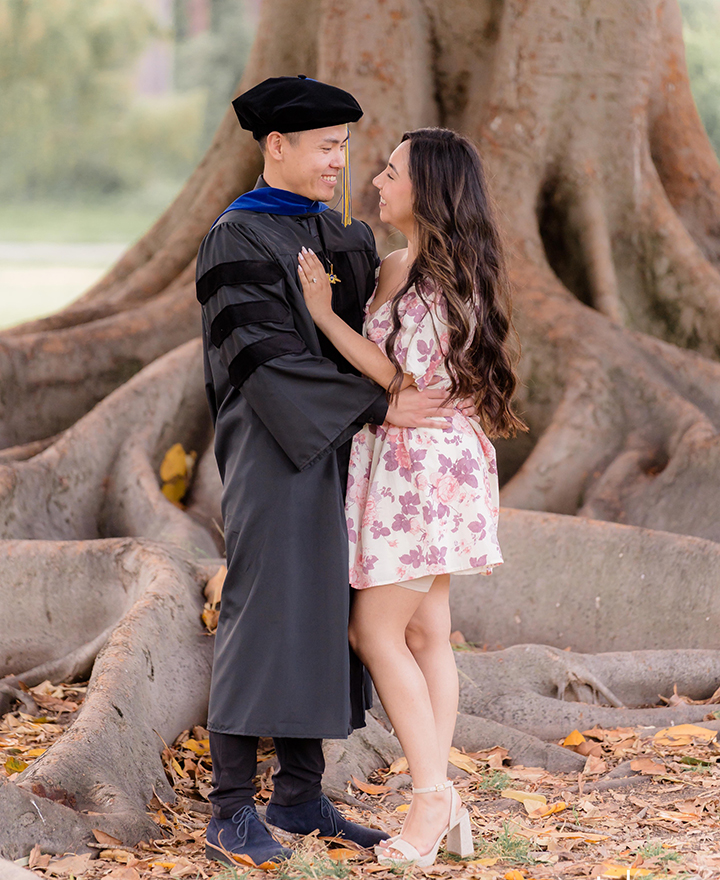 Plus, he loves the campus’s location. “UCI made me fall in love with Irvine as a city,”
Tran says. The university remains an important part of his life for another reason:
His wife, who he met at UC Merced, is an accountant at UC Irvine. He proposed as he
was nearing the end of his graduate studies and she was working on campus.
Plus, he loves the campus’s location. “UCI made me fall in love with Irvine as a city,”
Tran says. The university remains an important part of his life for another reason:
His wife, who he met at UC Merced, is an accountant at UC Irvine. He proposed as he
was nearing the end of his graduate studies and she was working on campus.
Putting econ to work
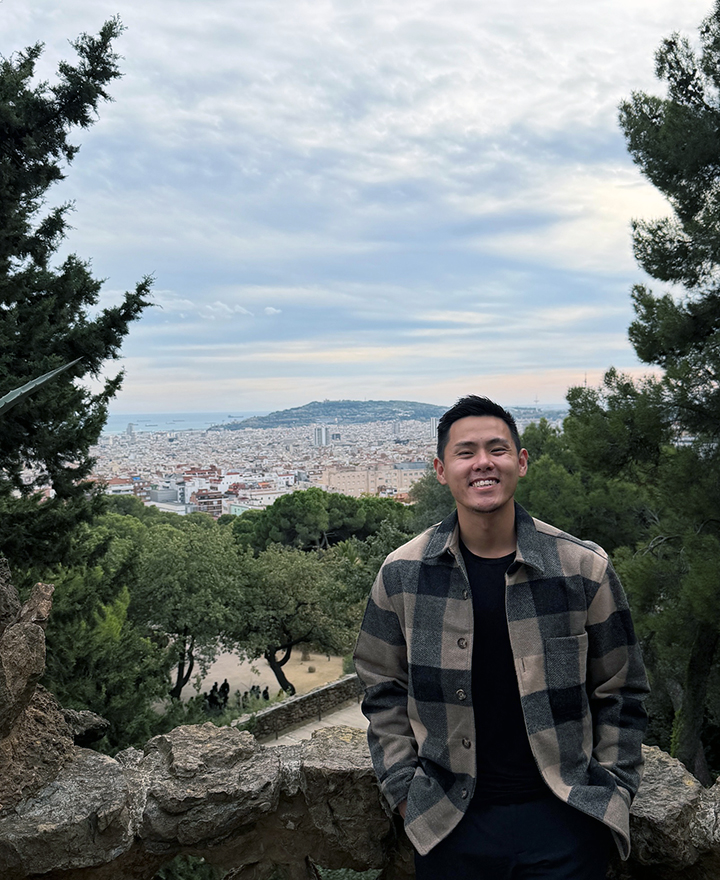
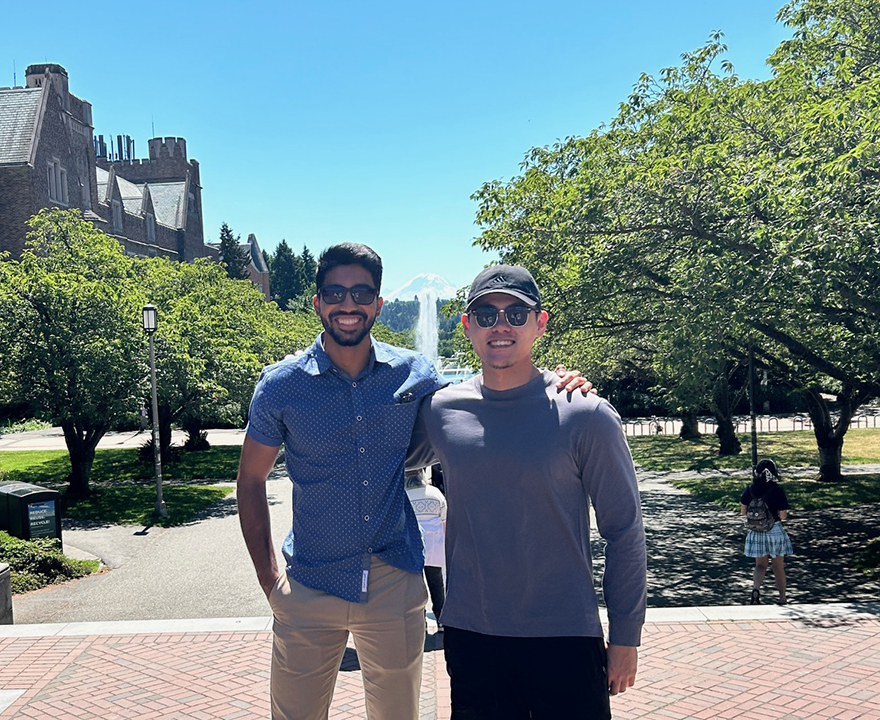
During his penultimate year of the doctoral program, Tran responded to a department email sharing internship opportunities. He and one of his closest friends in the cohort, Parush Arora, Ph.D. ’24, both landed internships at Amazon and spent a summer in Seattle working for the retail giant. Tran ran a project estimating the economic impact of the “Fulfilled by Amazon” program which enables small businesses to have the company sell and ship their products with the idea that lower shipping costs and faster delivery create a net benefit to sellers.
After graduating, Tran returned full-time to Amazon, where he worked on optimizing seller fees in India, trying to strike the ideal balance for buyers, sellers and the company.
“Of course, students can enter an academic career,” says Rocheteau. “But there are many other exciting options outside of academia where the tools learnt in the Ph.D. are very valuable. It can be at consulting firms (several students received amazing offers this year), tech firms (like the firm where Derek is currently working at), finance industry and so on.”
For Tran, the vast array of opportunities to put his economics degree to work was a revelation.
“I thought I was going to go into academia, but the world outside of academia is so large for economics,” Tran says. “Economics builds the exact skillset you need to succeed as a data scientist, applied scientist, data analyst, or machine learning engineer. Even since I’ve graduated, I’ve had opportunities to combine causal inference using machine learning methods and state-of-the-art AI.”
 Tran continues learning about and applying those emerging methods to his day-to-day
work as a senior research scientist at Upstart. The publicly traded company originates
billions of dollars of loans each month, focusing on borrowers who have been turned
down for traditional loans. Tran designs experiments, builds models, and uses his
well-honed intuition to contribute to a team that aims to improve financial inclusion.
Tran continues learning about and applying those emerging methods to his day-to-day
work as a senior research scientist at Upstart. The publicly traded company originates
billions of dollars of loans each month, focusing on borrowers who have been turned
down for traditional loans. Tran designs experiments, builds models, and uses his
well-honed intuition to contribute to a team that aims to improve financial inclusion.
“Credit is key to American success, and we use AI and alternative data to originate loans for qualified individuals who fall outside traditional banking criteria,” Tran says.
Tran says he uses his economics degree daily, doing research and considering new avenues to generate income for the company.
“Economics is so much more than what you’ve learned. It’s such a wide, wide field that gives you the tools to apply to AI, sociology, biology or whatever you like,” says Tran. “There is so much you can explore. Don’t be limited by what you think traditional economics is.”
-Christine Byrd for UCI Social Sciences
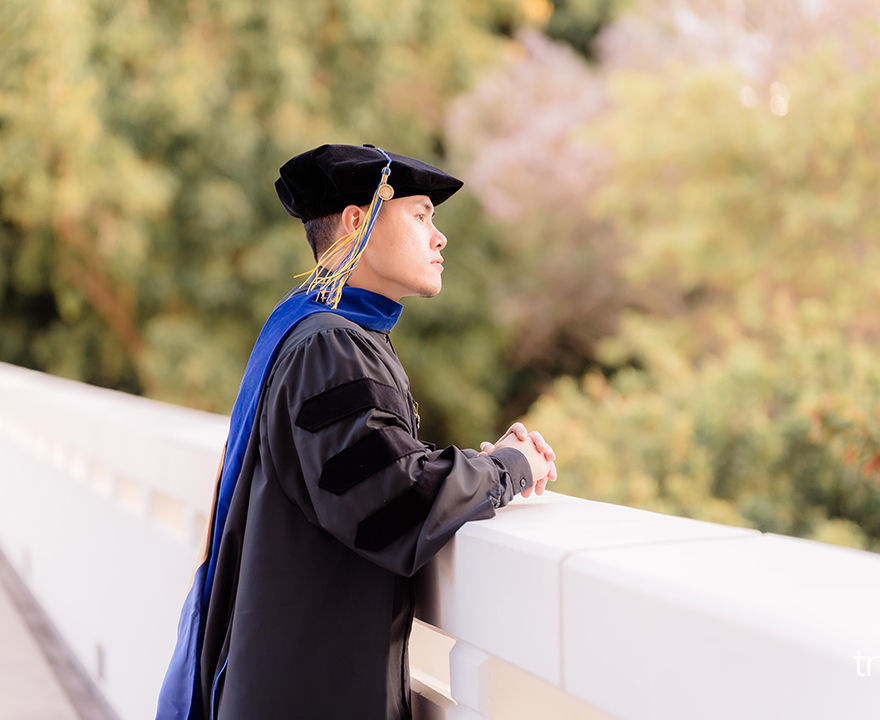
-pictured: Derek Tran before his Ph.D. commencement ceremony. Tran in Seattle. Tran
with his fiancé in Aldrich Park at commencement. Tran with Arora in Seattle.