


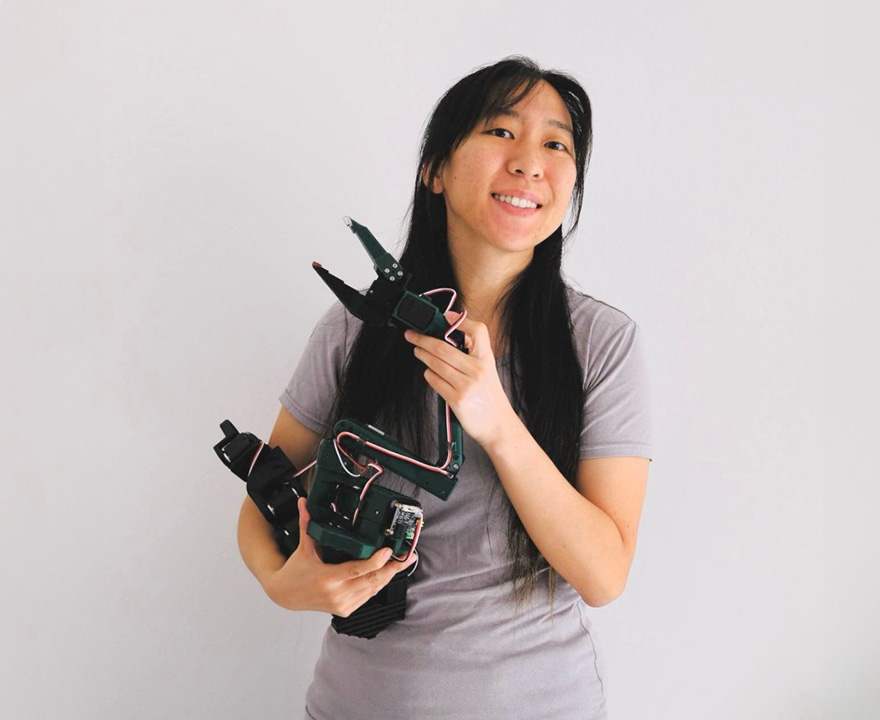
From neurorobotics to Riot Games
 Each day, millions of people log in to work together in small teams to slay monsters,
destroy enemies and save their planet.
Each day, millions of people log in to work together in small teams to slay monsters,
destroy enemies and save their planet.
Cognitive scientist Tiffany Hwu M.S. ’17, Ph.D. ’19, is part of a cadre of specialized researchers who enhance the player experience in these virtual worlds created by Riot Games, one of the biggest multiplayer game developers.
“The role of games throughout human history has been to provide a safe environment where you can test ideas, develop different skills, socialize, explore different worlds and let your imagination run free,” says Hwu. “It’s a playground for testing ideas in artificial intelligence and scientific hypotheses of the body and brain connection.”
The relationship between the brain and body fueled Hwu’s graduate research and projects she worked on with Toyota Research Institute, Northrop Grumman and HRL Laboratories during her time at UC Irvine.
“Something the Ph.D. really helps with is identifying the right questions, coming up with hypotheses and testing them, and reading about and integrating the work from other labs,” Hwu says. “And now, in industry, those principles contribute to a real product that serves millions of people every day—live.”
Engineering in the park
As a kid in San Diego, California, Hwu enjoyed tinkering with code and reading about psychology.
“I was a quiet child, and still am quiet now. That sparked an interest in wanting to understand what makes people the way they are,” says Hwu. “Why am I the way I am? Why are other people the way they are?”
As an undergraduate at UC Berkeley, she double majored in cognitive science and computer science, and worked in the Computational Cognitive Science Lab, founded by pioneering professor Tom Griffiths.
”At first, I thought computer science was more marketable, but then the two really started to merge,” Hwu says. “I realized that human intelligence and machine intelligence have some similarities and some ability to help each other.”
Before jumping into industry, Hwu wanted the opportunity to devote time to exploring her own research questions through a graduate program. She applied to a number of labs doing work that interested her, including the Cognitive Anteater Robotics Lab, or CARL, led by Jeff Krichmar, professor of cognitive sciences (now emeritus), and started touring them after she received her acceptances.
“In talking to Jeff Krichmar and visiting the students and postdocs in his lab, I could tell it was a very collaborative and supportive environment,” Hwu recalls. “I felt this extended to the rest of the cognitive sciences department where many other professors were very supportive as well, and wanted the graduate students to succeed.”
UC Irvine’s beautiful campus made the choice even easier. “It’s sort of shallow to judge a place by the aesthetics, but I went to Aldrich Park and I just loved the round shape of the campus and the atmosphere,” she adds. “I could imagine myself doing engineering in the park.”
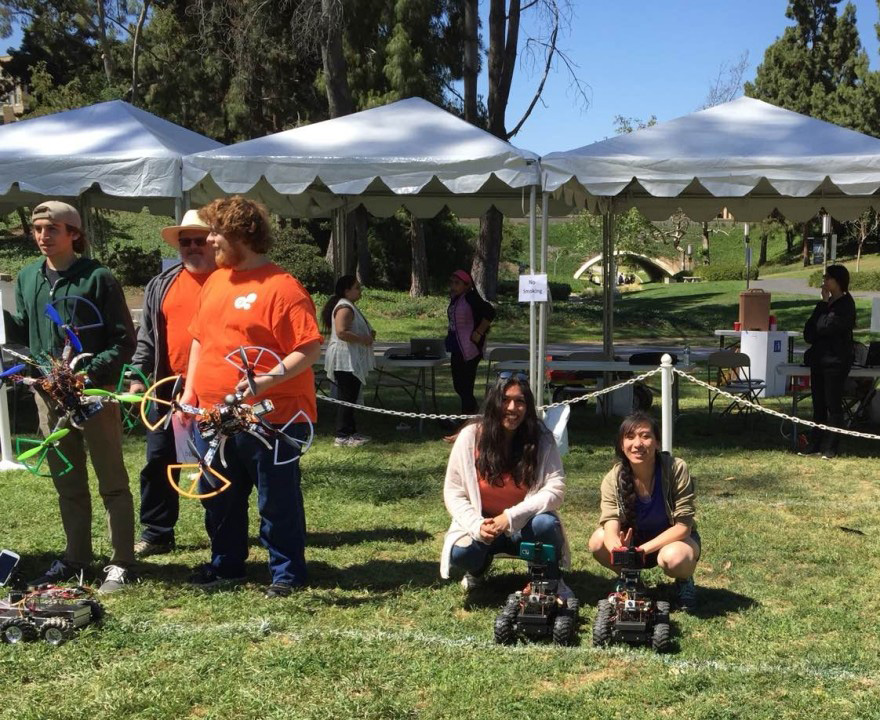
It turns out, she would do exactly that. Hwu and colleagues from CARL often took robots they built from scratch to Aldrich Park. Driving them around, they tested their hypotheses about how animals use different parts of their brains to navigate their environments. During the graduate program, she earned her master’s in cognitive neuroscience – available to students en route to the doctoral degree – and was recognized with the School of Social Sciences Merit Fellowship, the Fellowship in Honor of Christian Werner, and an honorable mention for the National Science Foundation Graduate Research Fellowship. Her dissertation focused on spatial navigation for neurorobotics, modeling the brain circuitry that helps humans and animals move through the world.
“When I think of AI, I think of embodiment – the relationship between the body that you are assigned to and how it has to interact with the environment. I believe the next frontier in artificial intelligence is physical AI, and getting robots to do dexterous tasks,” says Hwu. “It's certainly fun that what I studied in grad school is now being applied in today’s challenges.”
Not only is neurorobotics being applied to today’s challenges in industry, but also being taught in classrooms—where students can learn from a textbook Hwu co-authored.
“Tiffany was one of my favorite students and one of the best researchers I had the pleasure of advising,” says Krichmar. “She was also an outstanding teacher, which led me to ask if she would co-author a textbook on Neurorobotics (MIT Press, 2022).”
Hwu says she’s proud to have been part of the process of creating the book, which preserves unique aspects of neurorobotics that grew out of Krichmar’s expertise and years of work by members of the robotics lab.
 Industry connections
As a graduate student working with CARL, Hwu began applying neurorobotics to real-world problems. She collaborated with departments across campus to use the Toyota Human Support Robot to make remote learning more immersive and interactive for homebound students allowing, for example, a remote student to raise the robot’s hand in class or to pick up objects in the room.
“Because the department is so interdisciplinary, I always received a variety of very interesting feedback from people who work on the computational side or more biological side,” says Hwu. “Also, we had collaborations with the School of Education and the computer science department that led to interesting ideas.”
Hwu held two off-campus internships while she was a graduate student. In one summer at Northrop Grumman, she helped develop robots designed for search and rescue missions – work that later informed her dissertation. Then, she interned at HRL Laboratories where she worked on self-driving cars.
“Something I really liked about the cognitive science department at UC Irvine was that they brought in alumni from industry to tell us what they were working on and how they applied cognitive science to their jobs,” says Hwu. “I really like academia and have considered that path as well, but not every grad student is going to end up in academia, so it was good to see that there are lots of different opportunities available to graduates.”
After graduating, Hwu stayed full-time at HRL, using her expertise in human-machine interaction to advance self-driving cars and design interfaces for pilots in Boeing aircraft. Until Riot Games came knocking.
Becoming a gamer
A recruiter from Riot Games reached out to Hwu during the pandemic. Although Hwu wasn’t a League of Legends or VALORANT player at the time, she was familiar with the company which attracts more than 100 million players each month. In 2016, Riot Games helped launch the nation’s first public university Esports Arena at UC Irvine, where college players compete in the company’s best-known games, League of Legends and VALORANT.
The company wanted Hwu to join a team it was spinning up that would use deep reinforcement learning to train virtual bots to play the games. The bots could be used both to improve the games themselves, and to help new players practice. The role allows her to bring the expertise about embodiment that she honed in graduate school to interdisciplinary groups of game designers and software engineers.
With deep reinforcement learning, Hwu helps train the bots to play the games by rewarding them for winning a game outright, or for specific actions that will help them on their path to victory. She finds it most interesting when the bots do something unexpected.
“You can craft a reward that you think will help the bot learn, but the bot will find a way to get the reward without doing what you expect,” Hwu says. “For example, it might discover a secret passageway or find a little corner of the arena that allows it to maximize the reward. It’s the perfect example of the environment and the body interacting to do things you don’t expect – and that’s how intelligence is made.”
Not just for machines, but for humans, too. Hwu explains that gamers who devote hours and hours to a game often develop strategies that were not intended by the game designers.
“Cognitive science helps us understand the human and machine interaction that goes on in a game, and how we can use the brain’s visual and auditory processes to keep the players engaged – whether they are experienced or new players,” Hwu says. “I’m able to think about the human players and what’s going on in their brains as they play the game.”
Even years after graduating, Hwu remains in touch with her classmates and advisors, attends alumni gatherings, and returns to campus to speak to current students.
“Since graduating, she has graciously given back with seminars on what working in the gaming industry is like to my classes and the Cognitive Sciences department,” says Krichmar. “Her advice has inspired our undergraduate and graduate students who want to work in industry.”
Adds Hwu: “UC Irvine’s cognitive sciences students and alumni are a good community to be a part of.”
-Christine Byrd for UC Irvine School of Social Sciences
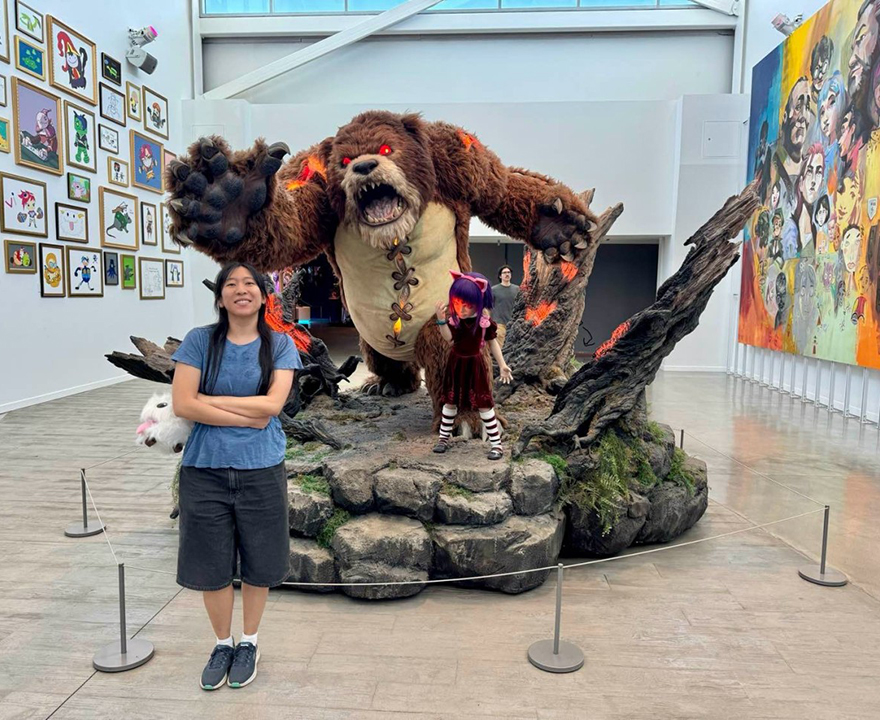
-pictured: Tiffany Hwu holding a robot. Hwu in Aldrich Park with CARL and at Riot
Games headquarters in LA.