


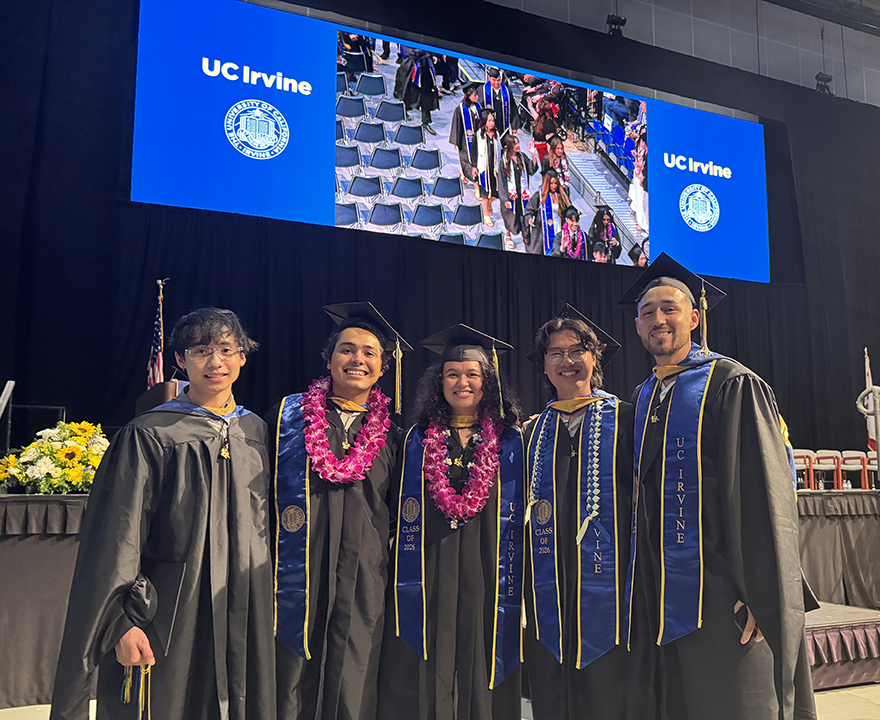
UC Irvine’s 4+1 PPE program celebrates its 10th graduating cohort
UC Irvine’s 4+1 master’s in Philosophy, Political Science and Economics marked a milestone this spring as the program celebrated its 10th cohort to graduate from the accelerated bachelor’s-to-master’s degree program. The six newly minted master’s recipients walking in the university’s June ceremony completed graduate-level research on topics ranging from artificial intelligence and criminal liability to Latino voting, organized labor, global finance and Mexico’s cartel crisis.
Administered by the Department of Logic & Philosophy of Science within the School of Social Sciences, the unique program allows students to earn a combined bachelor’s and master’s degree in just five years while developing an individualized, interdisciplinary course of study.
Creating pathways
PPE is one of two standalone master’s programs offered by the school. It was created
by Simon Huttegger, LPS Chancellor’s Professor, alongside Jeffrey Barrett, LPS Distinguished
Professor, who helped welcome the program’s first applicants in 2015. It has since
graduated dozens of students trained to critically evaluate individual and collective
decision-making and public policy.
“Our motivation to start the PPE program was to support UCI undergraduate students by allowing them to complete a rigorous master’s degree by just adding one more year to their undergraduate education,” says Huttegger. “The master's degree we envisaged was one that was flexible enough to, first, serve students from a diverse set of intellectual backgrounds by introducing them to closely related fields that approach the same set of issues from different perspectives, and second to allow them to enter different kinds of career paths afterwards."
Barrett points to another important motivation: “Talented UC Irvine students wanted to study with LPS faculty. Since we did not have an undergraduate major, this provided a way.”
The 4+1 program created a pathway for students who encountered LPS professors through Campuswide Honors courses and wanted to continue working with them. Its interdisciplinary approach prepares students for a wide range of academic and professional pursuits, explains Kyle Stanford, LPS professor and current director of PPE.
“The program offers an ideal background for students interested in careers in public service and public policy, as well as many other fields relying centrally on informed individual and collective decision-making,” he says. “It also offers an outstanding preparation for law school or for pursuing a Ph.D. in philosophy, political science, economics and a wide range of related fields.”
The program draws on faculty expertise from three of the school’s highly ranked departments: Logic & philosophy of science, ranked first in the world in five subfields and among the top 20 in all other areas of faculty specialization; economics, ranked 18th among public universities and 41st overall; and political science, ranked 20th among public universities and 41st overall.
“Philosophy equips students with tools to reason rigorously and facilitates ethical reflection, while economics provides tools for evaluating individual and collective decision-making,” Stanford says. “And political science provides an understanding of the real contexts in which ethical and economic principles must be applied. The three disciplines inherent in PPE are mutually supportive and a background in each is necessary for an individual to gain a robust understanding of social phenomena.”
The PPE experience
The number of applicants varies from year to year, Stanford says. “Self-selection
generates a consistently strong pool and we accept about half of those who apply.”
For students who commit to the program, PPE offers advanced training in ethics, logic, decision-making and public policy. Students have considerable flexibility in shaping both their course of study and culminating thesis, allowing them to work with faculty advisors across campus, even beyond the program’s three core fields.
This year’s graduates and their thesis projects reflect the breadth and depth of the program’s aim:
- Colin Bolek, advised by Yousuf Al-Bulushi, Associate Professor, Global and International Studies, “Interest Collapse: Finance as Mediating the Imperatives of Modern Global Capital”
- Cameron Cheng, advised by Brian Skyrms, Distinguished Professor, Logic & Philosophy of Science, “Coherence and Content: The Canonical Basis and the Limits of Symmetry”
- Kara Chizek, advised by Jeffrey A. Barrett, Distinguished Professor, Logic & Philosophy of Science, “AI Criminality and Chatbot Accomplice Liability”
- Isaac Guerrero, advised by Caesar D. Sereseres, Associate Professor Emeritus, Political Science, “Foreign Terrorist Designation, Just War Theory, and the Misgovernance of Mexico’s Cartel Crisis”
- Roman Marin, advised by Davin Phoenix, Associate Professor, Political Science, “Latinidad and the 2024 U.S. Presidential Hispanic Vote”
- Andrew Nguyen, advised by Walter Nicholls, Professor and Chair, Urban Planning and Public Policy, “Contested Municipal Spaces: Evaluating the Role of Electoral Labor-Community Coalitions in Orange County”
For Nguyen, who entered as a political science major and history minor, the program brought together topics in politics, law, labor, philosophy, history and public policy that he had spent his undergraduate years exploring.
“The three main disciplines together in one program isn’t super common in the U.S., more in Europe,” he says. “It was a great fit and not only helped me dive further into educational topics I’m passionate about, but also helped strengthen my future opportunities for grad school and law school.”
Nguyen first learned about 4+1 programs during his junior year, when a guest speaker in one of his courses discussed a different accelerated master’s option at UCI. Recognizing that there could be similar opportunities at UCI that aligned more closely with his interests, he began his search and discovered PPE. The program’s multidisciplinary approach was a great fit, and the opportunity to complete graduate coursework during his senior year meant some of those classes could still be covered by his undergraduate financial aid.
His Model United Nations adviser helped him review the application requirements and encouraged him to apply. And when program director Stanford later visited another student club Nguyen was involved in, his decision was made. He applied that spring and was admitted in May.
The program’s flexible curriculum became, for Nguyen, one of its greatest draws. “It’s not as restrictive in terms of curriculum as other programs,” he says.
He was able to choose from a variety of graduate courses to complete the program’s core requirements. He took doctoral seminars alongside Ph.D. students, including an economics course examining racial disparities in the United States and a labor and community scholars course focused on the history of unions and organizing in Orange and Los Angeles counties. He also completed a seminar in the School of Law on crime and punishment, where he studied alongside law students. The experience gave him an early look at the kind of work expected in doctoral and professional programs.
“I didn’t come from a heavy economics or law background, so there was a learning curve,” he says. “But I felt supported by the faculty and my classmates. The courses pushed me to break down advanced topics, be critical about analytical methods, and think about how we look back at history and consider how policies are implemented and measured.”
He also enjoyed the opportunity to meet and engage with students outside of his regular field of study.
“Don’t limit yourself to your field,” he says. “You have time to explore different things. I came across people in many different graduate, Ph.D. and law school programs, and that exposure was really valuable.”
Equally important was the connection he developed with the other members of his cohort who he now considers lifelong friends.
“One of the things that surprised me most was the community,” he says. “We all came in with different ideas, aims and goals, but we shared this experience and got to know each other and become a tightknit group. We worked through thesis ideas together, hashed out ideas, ate together and developed a real sense of community.”
For his thesis, Nguyen examined how labor-community coalitions form and sustain themselves and participate in municipal electoral politics in Orange County. His research considered the factors that make coalitions effective at the ballot box, as well as those that lead them to break up or disband.
“The thesis portion is open to a number of topics,” he says. “You can tailor the work to what you’re interested in, work with an advisor and develop an existing essay or start something new. That flexibility allowed me to explore an area that really intrigued me.”
The project also connects directly with his professional career path. After interning with University Professional and Technical Employees during his time as an graduate student at UCI, Nguyen was hired by the organization full time as a union organizer and labor representative. The work allows him to continue focusing on employment and labor law, collective action and contracts while staying in touch with mentors as the possibility of law school remains on the horizon.
The PPE year, he says, gave him time not only to expand his academic knowledge, but also to plan for how he wants to move forward. His advice to future students is to approach the program with that same mindset.
“Play on your interests and take courses that really pique your curiosity,” he says. “You’re in a room with people who have so many different ideas, so use that and push your limits. Learn, try things and rely on your community. Take it a quarter at a time and see where it leads – you’ll be amazed with what you’re capable of.”
Undergraduates interested in applying to the 2027 PPE cohort should plan to apply in spring of their junior year. Applications are due April 15 and decisions are made mid-May. Visit the PPE website to learn more about the program, admissions requirements and affiliated faculty.
pictured: Graduates in the 2026 PPE cohort at their June commencement ceremony in the Bren. Courtesy of LPS.