


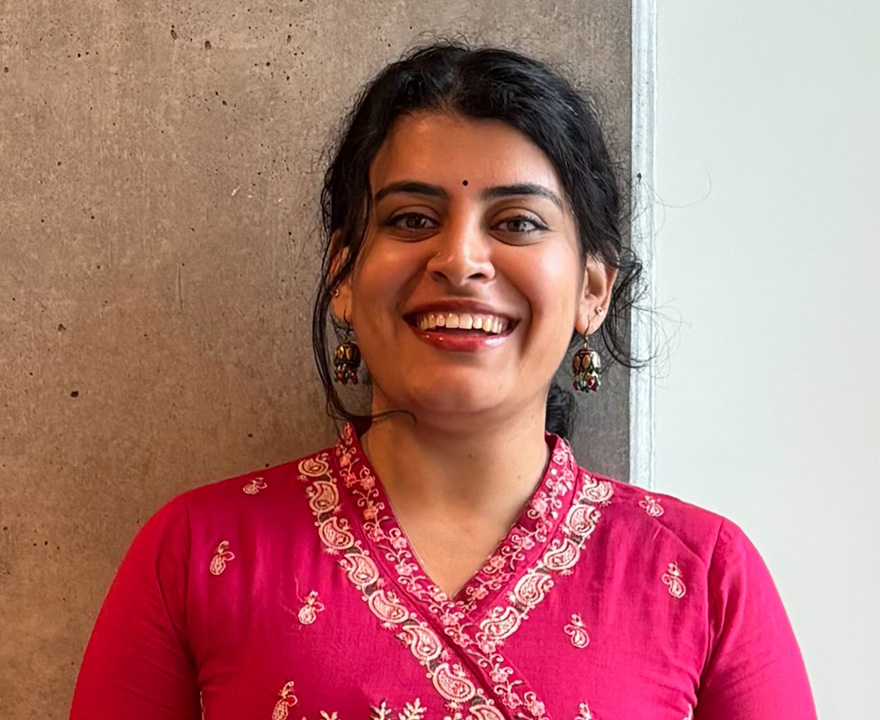
A global perspective
How does speaking more than one language affect children’s understanding of the social world around them? As a fourth-year UC Irvine cognitive sciences Ph.D. student, Sharanya Bashyam is pursuing a cross-cultural approach across the U.S. and India to help separate differences between bilingualism and general culture.
“I hope that my work helps contribute to a more global understanding of children’s cognitive development,” she says.
Originally from Hyderabad, India, Bashyam earned her undergrad in psychology at the University of Hyderabad before to moving to Mumbai to earn her master’s in clinical psychology at the Tata Institute of Social Sciences. It was there that she discovered her passion for research, and so she came to the states to pursue another master’s, this time in social sciences, from the University of Chicago.
“I have always loved languages. After moving to the U.S., I realized how rare it was for someone to speak more than one language, whereas in India, being bilingual was the norm,” she says. “I was curious then to examine how language diversity affects children’s understanding of the social world around them.”
When she was accepted into the UC Irvine cognitive sciences Ph.D. program in 2022, she knew she wanted to continue exploring these questions through her research.
“South Asians as a group are very underrepresented in psychological research,” she says. “I have therefore always aimed to incorporate a cross-cultural approach in my Ph.D. to develop a more representative understanding of social development.”
During her time as an Anteater, Bashyam has been a researcher in the Development of Social Cognition Lab under director and associate professor Nadia Chernyak who has served as Bashyam’s steadfast mentor.
“She consistently challenges me to think more deeply, ask better questions, while also providing the resources, feedback, and encouragement needed to reach those goals,” Bashyam says. “Her mentorship has been instrumental in helping me find my research identity and navigate the many challenges of graduate school.”
And Bashyam has paid it forward, in turn teaching, mentoring and guiding others. This year, she has been selected as a summer Graduate Dean’s Dissertation Fellow and as a co-recipient of the Kathy Alberti Prize in recognition of her promise as a future professor. For Bashyam, the awards represent a culmination of her research and mentoring work over the past four years, and she’s grateful for the recognition.
Below, she shares more about her educational journey, her proudest UCI moments, and how healthy hobbies have been one of her secrets to graduate success.
Q: What are some of your proudest accomplishments while at UCI?
A: Getting into a Ph.D. program will probably be one of my proudest accomplishments. I also love the environment in my lab and feel proud to have contributed to it! I also managed to conduct cross-cultural research, setting up connections with schools in India, something that our lab had not done previously. Also, every year since joining UCI, I have been a mentor at the GIC (Graduate International Connection) and it has been a very fulfilling role to mentor incoming international students and help them find home in Irvine.
Q: Who have been your faculty mentors while here, and what impact have they had on your graduate career?
A: My advisor, Nadia Chernyak, cognitive sciences associate professor, has been an exceptional mentor whose guidance and support has helped me grow as a researcher. She consistently challenges me to think more deeply, ask better questions and provides the resources and feedback to do so. Her mentorship has helped me find my research identity and she has modeled the kind of thoughtful and supportive mentor I hope to become in my own career. I am deeply grateful for her investment in my success and for the lasting impact she has had.
Q: When do you plan to complete your Ph.D.? What are your plans thereafter? How has UCI prepared you well for this role?
A: I will be graduating in June 2027 (next Spring). I am currently looking to apply to postdoctoral positions, where I hope to continue to study children’s social development through a cross-cultural lens, and better understand the effect of languages and early language environments. My training at UCI has equipped me with everything that a young researcher aspires to have: the ability to break down complex ideas into simple testable hypotheses, the skills to design and carry out experiments to validate these hypotheses, publish the results for both academic and non-academic populations, and an incredibly supportive mentor.
Q: Any unique life experiences that have guided your educational journey? Give us some background.
A: My family back home has always encouraged me to follow my passion and have been my loudest cheerleaders. Even when I made a switch from clinical psychology to research which turned out to be a longer path, they helped me reach where I am.
Q: Any other tidbits you’d like to share?
A: I think to get the best out of a Ph.D., it is important to not lose yourself or your non-academic hobbies. In fact, after starting my Ph.D. I got back into my hobby of reading, and fiction was an excellent distraction when my brain was overwhelmed with bilingualism. Also, movement helps and so does spending time outside, so I highly encourage people to see the sun and go to the beach more! We are so lucky to live so close to the water, and standing in front of the massive ocean, helps put life in perspective.