


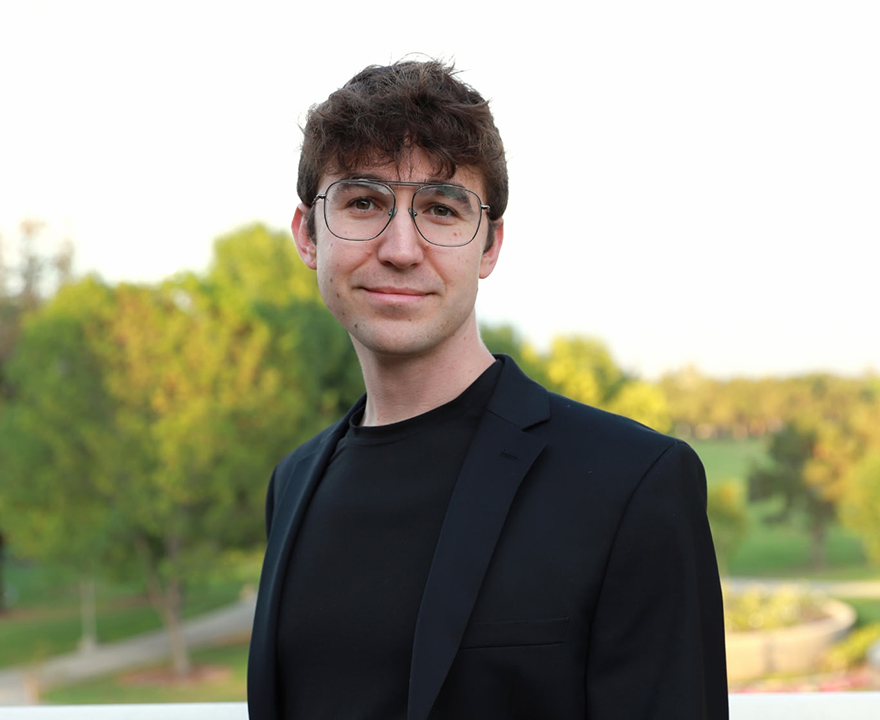
From first responder to undergraduate researcher
Long before he was building AI-powered language tools, Austin Wagner ’26 was confronting the limits of language in real time.
As an emergency medical technician in Orange County, where more than 100 languages are spoken, Wagner often relied on family members, colleagues or online tools to translate urgent health information. At the UC Irvine School of Social Sciences, Wagner has since earned his bachelor’s in language science while using artificial intelligence to make translation tools more widely available.
At UC Irvine, Wagner quickly joined research projects in language science and computational modeling, completing his degree in just 18 months. Before that, he spent seven years working as an EMT while exploring engineering, math, cognitive sciences and biology at various Orange County community colleges. After being accepted at both UC Berkeley and UC Irvine, Wagner chose to pursue Irvine’s language science program, which offers an interdisciplinary approach combining linguistics, neuroscience, computer science and artificial intelligence.
“As AI became more prominent, I wanted to understand it well enough to use it in research,” says Wagner. “Ultimately, language science, which combines linguistics and machine learning, allowed me to do that.”
Expanding access to translation
Wagner immediately joined Connor Mayer, assistant professor of language science, as a research assistant for the UCI phonotactic calculator. The tool leverages an AI model called Long Short-Term Memory to estimate how likely a native speaker is to think that a made-up word could be a real word in their language. After teaching himself Python, Wagner helped build and test new components of the model.
“Austin combines foundational knowledge of language science, the technical skills to apply computational models to language research, and a sunny disposition and enthusiasm that make him a pleasure to work with,” says Mayer. “He has also had a great deal of success in using AI to prototype and iterate on these models, which is becoming an increasingly important skill. The faculty in our department share a broad computational approach to language research, and it's a real pleasure to see students like Austin who have taken that approach to heart.”
 Soon, Wagner teamed up with graduate student Moldir Baidildinova to help train AI
language models on Turkic languages. One question guiding their work together is whether
an AI model can, like a human, more easily learn a language related to one it already
knows. For example, would a model trained in Turkish more easily learn a related language
like Kazakh, compared to a more structurally different language like Finnish? With
support from the Undergraduate Research Opportunities Program, Wagner presented his work in April at the Massachusetts Institute of Technology
for the 11th Workshop on Turkic and Languages in Contact with Turkic (TU+11). This
month, he spoke at the Southern California Undergraduate Linguistics Conference at UCLA.
Soon, Wagner teamed up with graduate student Moldir Baidildinova to help train AI
language models on Turkic languages. One question guiding their work together is whether
an AI model can, like a human, more easily learn a language related to one it already
knows. For example, would a model trained in Turkish more easily learn a related language
like Kazakh, compared to a more structurally different language like Finnish? With
support from the Undergraduate Research Opportunities Program, Wagner presented his work in April at the Massachusetts Institute of Technology
for the 11th Workshop on Turkic and Languages in Contact with Turkic (TU+11). This
month, he spoke at the Southern California Undergraduate Linguistics Conference at UCLA.
This project is particularly meaningful to Wagner because popular AI services like ChatGPT are widely available in English due to the abundance of digital text that can be used to train them. Languages with smaller populations of speakers – and less text available online – are far less likely to be included, leaving them out of reach for millions of people around the world.
“There are 7,000 languages in the world, and so many are very low resource languages, spoken by relatively few people,” Wagner says. “I hope some of my research in these low resource languages like Kazakh and Kyrgyz can help make AI models in the future accessible to more people.”
Lessons from research
Wagner is already putting his coding and linguistics skills to use to help others. He recently built an online translation tool to communicate with his “adopted grandma,” a native Vietnamese speaker who is slowly losing her English skills as her dementia progresses. So far, he says the tool works at translating about 70 different languages, and he hopes to continue expanding it.
To make the most of research opportunities at UC Irvine, and to strengthen possible future graduate school applications, Wagner wanted to apply his coding skills to other aspects of research, as well.
“Code is in everything – healthcare, video games, computers, weather and atmospheric chemistry,” Wagner says. “I really tried to broaden my perspective by talking to and working with people across campus.”
While exploring the chemistry department one day, Wagner came across a research poster describing how trees communicate by releasing certain chemical compounds. The research fascinated him – and required coding to analyze. He began assisting with metabolomics research in the lab of Celia Faiola, associate professor of ecology & evolutionary biology and chemistry, where Wagner used computational analysis to remove contaminant peaks, keep the strongest signals, and match the remaining peaks to molecular formulas.
Although Wagner completed his coursework at the end of winter quarter, he plans to continue volunteering as a research assistant in Faiola’s lab and with graduate student Baidildinova at least through the summer, building experience for future applications to graduate school, possibly in language science or a related field.
“Through research, I learned important skills like how to work independently, how to pace my own work, how to teach myself complex topics, and what high-quality work really looks like,” Wagner says. “When you know that everything you do is going to be peer reviewed and critiqued by highly knowledgeable experts, it makes you think carefully about every little detail.”
Making an impact
Beyond classes and research, Wagner has been politically active on campus. He served on the board of the College Democrats at UCI where he offered his photography skills for various events on and off-campus, including those for Irvine City Council member Melinda Liu. He now works part-time as a policy and legislative analyst in Liu’s office.
“This is completely different from everything else I’ve been doing, but I can bring a research perspective to my policy work,” Wagner says. “I enjoy research and learning about policies, looking at past decisions, voting patterns, and impacts. It’s been a great opportunity so far.”
Nearly a decade after he first embarked on his college journey, Wagner is excited to have earned his diploma while continuing UC Irvine research projects, working in the city, and preparing to apply to graduate schools in the future.
“It felt like I only had only a limited amount of time to do as much as possible at UCI, joining clubs, meeting people, taking on internships,” says Wagner. “I know that nothing is handed to you, so I’ve been working hard at every step to reach my goals. Hopefully, in the future, that will allow me to be impactful.”
-Christine Byrd for UCI Social Sciences
-pictured: Austin Wagner. Wagner with graduate student Moldir Baidildinova at the
Massachusetts Institute of Technology for the 11th Workshop on Turkic and Languages
in Contact with Turkic (TU+11).