


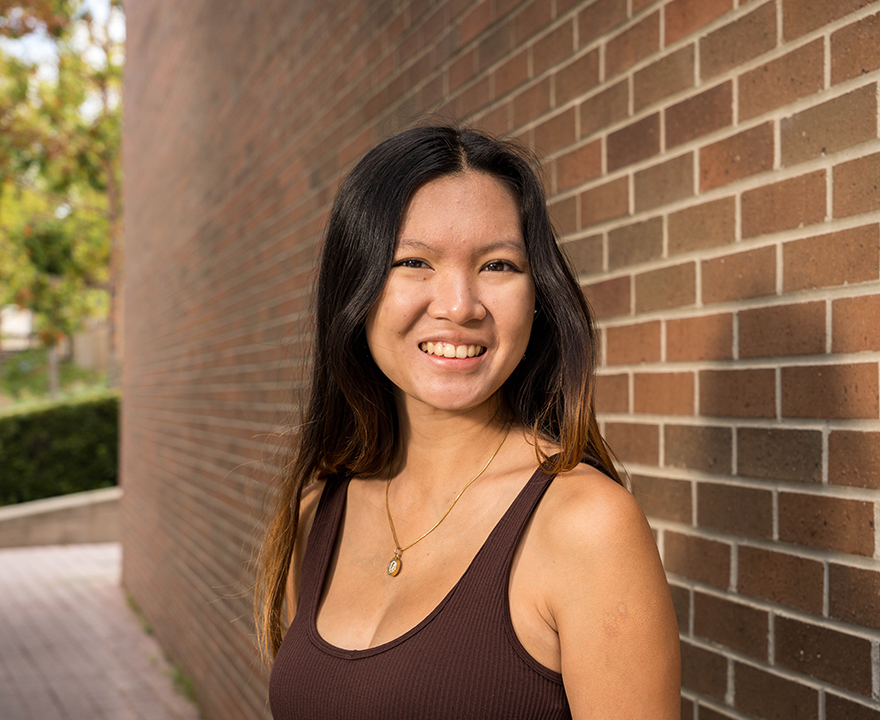
Areeyaphan awarded Moore Scholarship for Community and Social Change
Shalita Areeyaphan, a fourth-year psychology and biological sciences double major at UC Irvine, is a 2025 recipient of the Social Sciences Moore Scholarship for Community and Social Change. The $1,000 award supports students who demonstrate the most academic promise and potential to enact change and improve the community. Below, the Anteater from Honolulu shares how her studies and life experiences fuel her passion for medicine and her vision of returning to the islands to advance quality healthcare for Hawaii’s underserved populations.
What inspired your dual majors, and specifically at UCI? What interests you most about your work?
I’ve always been drawn to the study of human behavior and how we learn and adapt to our environment, so I knew before coming to college that I wanted to pursue a psychology major. In high school, I shadowed a clinical psychologist from Thailand who did her master’s program at UCI, and hearing her stories of her time at the school was how I first heard about it. Interestingly, when I began my college research, I focused on schools with an undergraduate pharmaceutical science program, which I thought I’d pursue alongside psychology. Although I quickly realized before I applied to colleges that pharmaceutical sciences didn’t align with the path I wanted to take into medicine, UCI was still very much on my radar, especially once I started considering a double major in biological sciences, which would allow me the flexibility to explore different aspects of biology. In the end, UCI was the best school I was accepted into for both programs.
Another important deciding factor that I had in mind was the location of the school. I knew early on that I wanted to attend college in a different state. As much as I love Hawaii, I figured that if I was going to be learning new things and meeting new people in college, I’d take it a step further by immersing myself in a completely different environment. This was the path that almost all of my high school classmates embarked on as well. Besides being a relatively safe city, something that greatly reassured my mom, I also had family nearby who could help make California a comfortable home away from home.
Ultimately, I committed to UCI for the community I found here. In my senior year of high school, other Campus Representatives like me flew out to my island to host an out-of-state admitted students event for Hawaii applicants, where I met current students from all walks of life who eased my concerns and inspired me to make the best choice for my future. Almost four years later, I continue to take pride in the work I’ve produced at UCI. My psychology and biological sciences majors sit at the perfect intersection for me to explore the mechanisms behind human behavior and health, granting me a holistic perspective on medicine. Especially after being exposed to healthcare settings and resources in a major state like California, I’m excited to take what I’ve learned and return to the islands to advocate for quality healthcare for Hawaii's underserved populations.
When will you be finishing your undergrad? What’s next?
I plan to graduate in spring 2026 and do one-two gap years back in Hawaii in order to gain more clinical experience, build meaningful connections with physicians from back home, and prepare for the MCAT. Ideally, I would attend medical school in Hawaii a year after I graduate, but if there’s anything that my undergraduate years have taught me, it’s that the more experiences I gain, the more I’ll truly understand what works best for me. I’ve found incredible fulfillment in granting myself the opportunity to change my mind and trust my gut instinct. Ultimately, I intend to pursue a specialty in either neurology or oncology while figuring out how much research I’d like to incorporate into my future career.
What would you consider your biggest accomplishment at UCI?
At UCI, I would consider my biggest accomplishments to be the impact I’ve had with my mentorship with different organizations. My favorite mentorship experience has definitely been with the Southeast Asian Student Association’s high school outreach program, Southeast Asian Leaders (SEAL). The aim of SEAL is to empower Southeast Asian youth to pursue higher education through workshops that prepare students for academic success and build on their sense of cultural awareness and community consciousness. In winter of my second and third year, I worked specifically with a cohort of mentees from Garden Grove High School to help craft individualized college portfolios. Witnessing my mentees grow from shy and reserved kids to enthusiastic and curious young adults made every commute through traffic worth it. I’ve had mentees from outside my group ask for my advice about attending college out-of-state and being pre-med, which I was always more than happy to share. It was through SEAL and other similar programs that I realized my love for mentorship and community outreach, something I channel into my work as a CNLM ambassador and Campus Representative.
While this was earned before I started college, the Reid J.K. Richards Foundation, a family foundation in Hawaii dedicated to helping other families who have suffered the loss of a parent or primary caretaker, granted me the Kamakaho’ohie Scholarship. This scholarship was created for the purpose of reducing the financial burden of students under the age of 25 who have lost a parent or primary caretaker through death.
What activities have kept you busy outside the classroom at UCI?
As a pre-med student, I’ve invested significant time and effort into community service, research, and clinical work. In the past, I conducted research on the psychodynamics of Dopamine Dysregulation Syndrome in Parkinson’s patients, the rates of obstructive sleep apnea in Native Hawaiian/Pacific Islanders vs Caucasians and am currently in the process of researching health outcomes and policy interventions for patients with limited English proficiency. Not only have I conducted neuroscience research, but I also volunteer as a student ambassador with the Center for Neurobiology of Learning and Memory (CNLM) to make neuroscience education accessible to the public through interactive brain activities, lab tours, and neuroscience competitions. In addition to my research, I’ve shadowed an oncologist and engaged in direct patient care at Kaiser Permanente Irvine to gain knowledge and exposure to work in the medical field. These are some of the ongoing activities that have been instrumental in fueling my passion for medicine and science.
However, my most meaningful activities have been with the various clubs I’ve come to find a vibrant and welcoming community in. For two years, I served as the president and the advisor for the Thai Culture Association, organizing and overseeing all club activities that brought the beauty of Thai culture to Thai and non-Thai students alike. Now, I serve as an event coordinator for the Women in Science Society and as a coordinator for the Southeast Asian Student Association’s high school outreach program, Southeast Asian Leaders (SEAL). These experiences are also highlighted in my introduction on the campus tours I lead as a Campus Representative, a job I’ve held since my first year of college. My commitment to mentorship and building community through cultural connections has been a common thread for many of these activities, something I’d like to build upon after my college journey.
Tell us what topics you’re pursuing through formal research.
During my second year, I collaborated with two other undergraduate research assistants from the Behavior, Emotions, and Affective Neuroscience (BEAN) lab to conduct and present our research at UROP on the mechanisms of social connectedness through a social sharing game, particularly through the lens of those experiencing depressive symptoms. Now, under the mentorship of a Ph.D. student in the Stark Cognitive Neuroscience of Memory Lab, I’ve been assisting with recruitment and data collection on a project that is analyzing the role of 2D vs 3D exploration in video games on memory ability in young adults. Currently, I’m brainstorming topics I’d like to conduct independent research on within the lab as part of my Campuswide Honors thesis requirement, with my primary research interests being in Alzheimer’s disease or neurogenesis.
Who has played an important mentorship role in your life thus far? Specifically at UCI?
My mom has played a significant role in shaping my character, inspiring me to be independent, hard-working, and resilient. As a restaurant owner and a single mom of two, I’ve watched her navigate the uncertainties that came with my dad’s cancer diagnosis and eventual passing and starting up a new business post-pandemic. Not once have I witnessed her break down under pressure despite how much stress I knew she was facing. Having grown up poor and raised by her grandparents, my mom sought to grant me and my sister the best lives she possibly could, supporting my ambitions and setting an example of how to handle life’s challenges with grace and unwavering determination. She has given me the space to make my own decisions and mistakes and learn from them, while still serving as my home base for support and advice.
At UCI, I found a mentor in Alina Tu, a Ph.D. student in the neuroscience department who leads the current research project I’m assisting with in the Stark Lab. As I navigate the independent research process, she has guided me with patience and gentleness with refreshing honesty, often seeing her old undergraduate self in me. Not only has she taught me the importance of seeking out mentorship from others if needed, but she has also encouraged me to not shy away from the numerous ways my path could change in the future.
Are there any unique circumstances or life experiences that have played a major role in where and who you are today?
Throughout my middle school and high school years, my dad fought a long and difficult battle with stage 4 acute myeloid leukemia. In between homework, extracurriculars, taking care of my younger sister, and helping out at my mom’s restaurant business, I’d spend hours at the hospitals and rehabilitation facilities that my dad would stay in doing my own research on available cancer treatments. Because I was too young to fully handle the weight of my situation or begin to understand the numerous scientific articles I encountered in my Google searches, I had to learn how to be resilient and independent not just for myself, but also for my family. After my dad passed away in my sophomore year of high school, what started as admiration for the doctors and nurses that treated my dad turned into a desire to pursue medicine myself.
Growing up in a restaurant also had a surprisingly strong influence on how I approached the delicate balance that was school and my home life. I have a bittersweet relationship with my family’s restaurant; my childhood self wished that I didn’t have the obligations that I did, but I owe it to the restaurant for my ability to multitask and work well under pressure. As a low-income student at a prestigious private high school, I also had to learn how to advocate for myself and focus on creating rather than finding opportunities. I was aware that my parents didn’t have the finances or connections that most of my classmates afforded, so I invested most of my efforts into excelling in classes, establishing meaningful relationships with my teachers and closest friends, and building my skills in the few extracurriculars I had time to pursue while prioritizing my family responsibilities. It was through my determination to persevere under my circumstances that I was able to fulfill my dream of attending college out-of-state once my family started earning more income. Now, as I close in on my final year at UCI, I’m proud of my past self for being able to remain ambitious and optimistic in the face of uncertainty and stress.
Where can you most often be found on campus?
According to my friends, I’m most often found in the biological sciences area, either studying (or taking a nap) at the Science Library, attending a lecture, or running another experiment at my research lab. If I’m not there, I can also be found leading a tour through outer Ring Road, stopping at various points along the way.
What’s your best memory thus far from your undergraduate experience at UCI?
Currently, I am completing coursework in European public health, endocrinology, social psychology and health, and advances in biomedical sciences to fulfill my major requirements in the Netherlands while meeting new people from all over the world. I’ve always wanted to study abroad in college, so being in the international melting pot that is the charming city of Maastricht feels like a dream come true. I’ve had the amazing opportunity to travel to places like Brussels, Berlin, Paris, Utrecht, and Switzerland, with much more to hopefully come! Despite my introverted nature, I’ve made efforts to push myself out of my comfort zone for the sake of building new friendships and embarking on the most exciting adventures, from solo traveling to learning the Dutch language. I’m also proud to announce that after 21 years of living, I finally know how to ride a bike, and I’ve been using that to get me everywhere in the city, from my classes to coffee runs to the farmer’s market.
Any other interesting tidbits you would like to share?
Someday, I would like to have a stable enough income where I’d feel comfortable buying the jumbo Peter the Anteater plushie from The Hill with no regrets. Also, I survived 4 years of UCI without a car – it is in fact possible.