


Typing physics
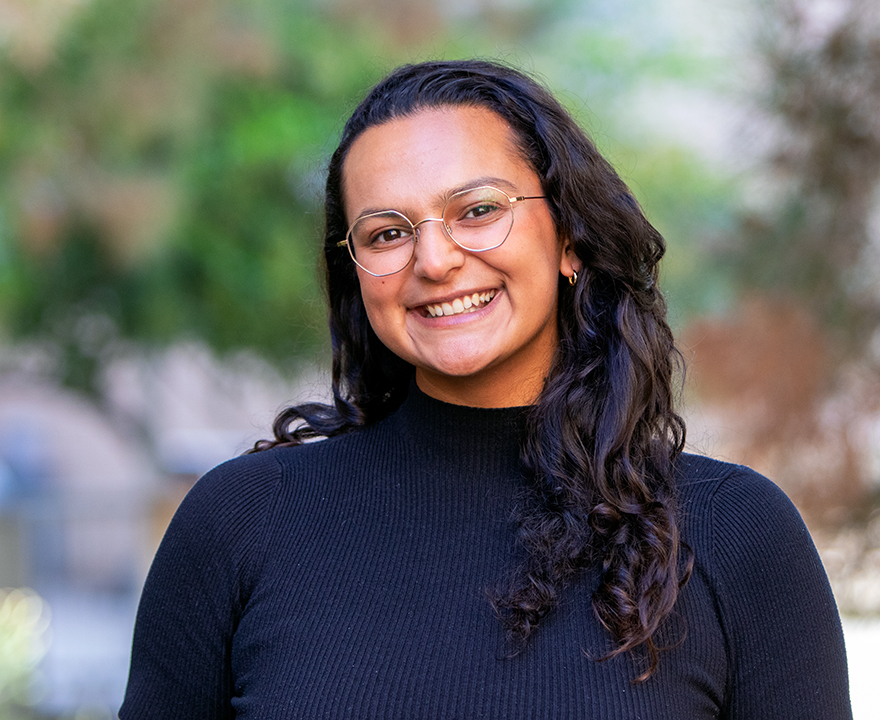
The physics research landscape changed significantly during and after WWII, and we’re still working to understand it, says India Bhalla-Ladd. A graduate student in the Department of Logic & Philosophy Science at UC Irvine, her works sits at the intersection of physics, philosophy, and the history of science. In an award-winning historical essay, she detailed the contributions of a group of technical typists who worked during the 1960s and 70s for The Physical Review, the biggest American physics research journal. This unique group, she explains, was responsible for resolving a crisis of scientific communication that emerged in response to the rapid growth of the physics research community post-WWII.
“They worked processing the handwritten manuscripts that came into the journal, and their technical contributions laid the foundation for modern technical typesetting,” she says. “I find it an especially interesting case study because it explores the contributions of a previously overlooked group of people to the smooth functioning of a research community, and poses questions about how intra-scientific communication has changed in response to major historical events.”
The work came out of original archival research she conducted at the Niels Bohr archive of the American Institute of Physics, which recently featured her efforts. Below, the DC/Boston native shares more about her research and why UCI – and specifically the LPS department - is the perfect environment in which to pursue it.
Q: Give us a little background on your educational journey. Where did you go for undergrad? How did you decide on UCI for your Ph.D.? What interests you most about your work?
A: I earned my bachelor’s in physics & philosophy at Yale University, and my master’s here at UCI in the physics department.
I’ve been interested in the intersection of physics, philosophy, and the history of science since high school – my high school physics teacher introduced me to the philosophical debates over the foundations of quantum mechanics in the 1920-30s among Einstein, Heisenberg, Bohr, & von Neumann and gave me a book on the history of the top quark. As I continued in my studies, I learned more about how philosophical work has been critical to solving and formulating deep problems in the foundations of physics, and I just got hooked on the interdisciplinary approach. The more I work in this field the more I’m excited to see how pervasive philosophical issues are in modern physics, and how a historically-informed perspective is especially helpful in parsing them.
I originally came to UCI for a physics Ph.D. in particle theory – with the intention to work as a philosophically-informed physicist. After Yale, I had spent a year as a visiting scholar at the University of Cambridge working with Hasok Chang; here I was introduced to the Cambridge HPS school, and the importance of integrating history & philosophy of science with physics practice. As a result, I chose UCI in part due to the close relationship between the physics department and the LPS department. Two years into my physics Ph.D. I realized that my ultimate academic goals were more appropriately suited to the foundations of physics, so I transferred to the LPS department to work with Jim Weatherall full time. I’m currently pursuing research in philosophy of physics, with a special interest in the history and philosophy of particle physics and quantum field theory. It makes me really excited to be in a department whose academic expertise is perfectly suited to help me pursue this research.
Q: Tell us about your research. What problem will your findings help solve?
A: I am interested in the conceptual foundations of particle physics – with particular regard to gauge theories and quantum field theory – and how communities of scientists conduct research . I am a big believer in the idea that a successful approach to these problems will involve dedicated philosophical & historical work regarding both theory and experiment.
Q: Where can your work be found if someone wanted to learn more about your research
A: Published papers include:
- An extended version of my essay was recently published in Studies in the History & Philosophy of Science (https://doi.org/10.1016/j.shpsa.2026.102147). My essay for the FHPP can be found online on the prize announcement page.
- I also recently had a paper accepted for publication for the 2027 December Conference Proceedings of the Philosophy of Science Associations’ 2026 Biennial Meeting entitled “Cluster Decomposition and Entanglement in Perturbative Algebraic Quantum Field Theory.” A preprint will be available on my website soon.
- India Bhalla-Ladd Ginnett, I. & Tait, T. Leptogenesis During an Era of Early SU(2) Confinement. Physical Review D. https://doi.org/10.1103/nmpt-fwz6.
- Martínez-Palomera, J., Lira, P., India Bhalla-Ladd, Förster, F. & Plotkin, R. M. Introducing the Search for Intermediate-mass Black Holes in Nearby Galaxies (SIBLING) Survey. The Astrophysical Journal 889, 113. issn: 1538-4357. https://dx.doi.org/10.3847/1538-4357/ab5f5b (Jan. 2020)
Other working papers with preprints (including a paper with Jim Weatherall and fellow UCI Ph.D. student Eleanor March, https://arxiv.org/abs/2603.19518) can be found on my website.
Q: Funding is a big part of graduate work. What organizations, foundations, and/or others have supported your research while you’ve been at UCI?
A: I am currently a GSR for Jim Weatherall in my capacity as the managing editor and book review editor for the Philosophy of Science Journal which is based at UCI, with Jim as editor-in-chief. I’ve also worked as a GSR on Jim Weatherall’s NSF grant entitled ``Symmetry, Structure, and Dynamics in Classical Field Theory.” I’m a recipient of the Graduate Dean’s Recruitment Fellowship from the School of Social Sciences, the Chancellor’s Fellowship from the School of Physical Sciences, and I was a AAS NOLP Osterbrock Fellow, which funded me in my capacity as a member of the PACE leadership team in the physics department.
Q: Your recent APS award is the latest in a series of recognitions you’ve received throughout your academic career. Can you share some of your other notable accomplishments and professional activities?
A: Awards (Undergraduate-Present)
- 2025 APS Forum on History & Philosophy Essay Contest
- 2024 UCI Graduate Dean’s Recruitment Fellowship
- 2022 NOLP Osterbrock Fellow
- 2022 UCI Chancellor’s Fellowship
- 2022 Epistemology of the LHC Conference Travel Scholarship
- 2021 Howard L. Schultz Prize (awarded annually to an "outstanding senior in the Physics department" by the Yale Physics department in recognition of academic and research achievements at Yale)
- 2020 Sigma Pi Sigma
- 2020 STARS II Research Scholarship
- 2020 Timothy Dwight Bergin Fellowship
- 2019 Timothy Dwight Richter Fellowship
- 2018 Yale Astronomy Department Fellow
UCI Campus Activities
- 2026-Present UCI Philosophy of Physics Reading Group Organizer
- 2025-Present Managing Editor & Book Review Editor for Philosophy of Science
- 2025-Present UCI Feminist Philosophy of Science Reading Group Leader
- 2022-2024 UCI PACE Leadership Team Member
- 2023-2024 UCI Physics Department UNITY President
- 2022-2024 UCI Physics DECADE Representative
- 2022-2024 UCI Race and Queer Feminist Theory Perspectives on the Philosophy of Physics Project Organizer
Q: Who have been your faculty mentors while here, and what impact have they had on your graduate career?
A: In the physics department, I was mentored by Tim Tait and Daniel Whiteson. Tim taught me the ropes of particle theory and phenomenology, and Daniel fostered my interest in machine learning methods in particle physics experiments. Both of them were fantastic research mentors, and incredibly supportive as I navigated my career shift into LPS.
In LPS, I work primarily with Jim Weatherall in philosophy of physics, as well as Cailin O’Connor in social epistemology. They changed the trajectory of my career in welcoming me to LPS. I feel so lucky that I get to work in this department, surrounded by so many like-minded academics.
Q: When do you plan to complete your Ph.D.? What are your plans thereafter? How has UCI prepared you well for this role?
A: I am in my third year of the LPS Ph.D., so an estimate is a little hard at this point, but anytime between 2028-2030 would sound reasonable to me. I aspire to continue working in academia, as a post-doc or eventually a faculty member. UCI has given me a strong and unique technical foundation in the history, philosophy, and foundations of physics that I will take with me wherever I go next.
Q: Any unique life experiences that have guided your educational journey?
A: I went to an all-girls school in Washington, DC on the close of the Washington National Cathedral, the National Cathedral School. It was a really special, formative high school experience. It’s possible I wouldn’t have known about the intersection of philosophy and physics if not for the teachers and mentors I had there.
Q: Any other tidbits you’d like to share?
A: I was invited to give a talk on this project at the 2026 APS March Meeting this past year as part of the award, which was really exciting. At this conference, I met the members of the APS Forum on the History & Philosophy of Physics. It was fantastic to see a community of historians and philosophers of physics at home within the APS organization.