


AI and local democracy
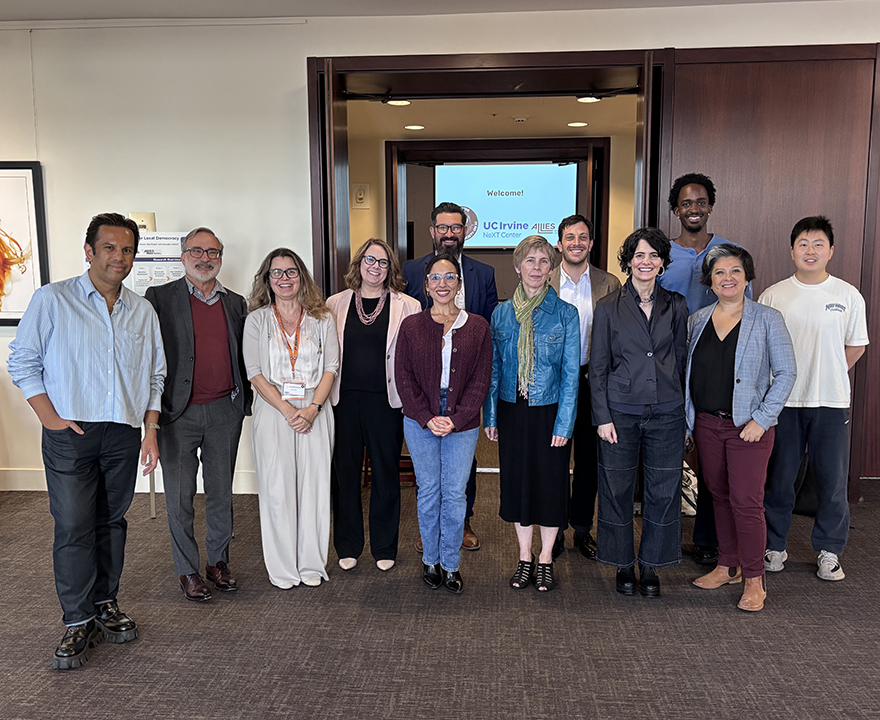
On October 13, researchers from the University of California and leaders from local non-profits, community organizations, and city and state government convened at UC Irvine and online for the first of three Policy Innovation Days to share expertise and insights on municipal chatbots. Funded by the Social Science Research Council (SSRC) and the Engineering+Society Institute on AI at UC Irvine (ProperAI) and enabled by the Alliance for Local Leaders International (ALLIES), this campus and community collaborative is working to better understand and measure how interactions with AI-enabled tools on city and government websites help or hinder residents and their overall civic engagement.
“Our goal is really to bridge the divide between policy makers and the research community so that we can better understand the usefulness and impact of these tools,” said Bill Maurer, UC Irvine social sciences dean and professor of anthropology and law, in his welcoming remarks. “There are clusters of us working on these questions while municipalities are simultaneously rolling out AI to their constituents, so it’s a great opportunity to bring people together to share what’s working and what needs work.”
As the project’s principal investigator, he helped create the interdisciplinary group that’s spearheading the effort. Joining him are UC Irvine colleagues Athina Markopoulou, professor of electrical engineering and computer science and director of ProperAI, Jackie Ku, ’26 political science Ph.D., and Olivia Figueira, ’26 computer science Ph.D.; and Alliance for Local Leaders International’s (ALLIES) Ben Polsky, ethics and technology practitioner fellow at Stanford and director of AI and technology programs, and Trevaughn Latimer, director of strategy and operations. They received a $30,000 SSRC grant in June to host the three-day series and develop evaluation tools and democratic engagement indicators for municipal chatbots, while research by the Ph.D. students has been supported by ProperAI to inform these convenings.
Following Maurer’s welcome, Camille Crittenden, executive director of the Center for Information Technology Research in the Interest of Society and the Banatao Institute (CITRIS), delivered opening remarks, offering a lay of the AI policy landscape with an overview of evolving legislation and executive actions on intelligence at the state and national level.
“In all of the work that we’re doing in this arena, we should think about how chatbots might help promote democracy within the cities that we’re working with,” she said, adding that while state policies may not apply directly to cities, they can be useful models to review and adopt. Additional talking points touched on the importance of ensuring transparency, governance, auditing and accuracy in the information provided by these tools, providing clear escalation paths to human experts, and considering how residents’ experience with online automated tools can engender or undermine trust in civic government.
The first of two panel sessions followed, focusing on real life lessons learned from chatbot launches at the city level with Polsky serving as moderator.
“Today, we’re exploring a seemingly simple question: Can AI help local government work better for the people it serves?” he said. “Democracy isn’t just about elections and public hearings; it’s experienced through everyday interactions with government. Can I get the right permit? Can I learn a service in my preferred language? Can I reach the right department when I need help? When those interactions are slow, confusing or inaccessible, residents can feel shut out of their own government.”
Chatbots have begun to be seen as tools that can fill these gaps and open new opportunities for more democratic governance – but, as use cases presented in the panel showed, they don’t always perform as intended.
Maurer shared findings from a summer study he and a team of UC Irvine researchers conducted to get a baseline understanding of operational trajectories, governance structures and public satisfaction outcomes of early municipal AI implementations across five cities in Southern California.
“Our work was looking at how cities are using chatbots and the types of problems they’re hoping these tools will solve,” Maurer shared. “Some of the lessons learned seem really basic, but they actually open up a huge can of worms.” He pointed to an off-the-shelf product designed for cities that, while seemingly requiring a low-level implementation lift, cast too wide a net as it scanned old websites and returned outdated information. Another issue they discovered highlighted just how lengthy chats could get when searches aren’t precise.
“It was really striking to me in one interview where lots of queries were coming in about permits,” he said. “If you put into the chat, colloquially, ‘How do I get my permit?’, the chatbot found 20 different kinds of permits and returned irrelevant information that led to frustration for the end users.” Based on the token payment structure underlying these tools, costs that seemed low in the procurement phase could increase astronomically, and quickly, he said.
These were all major sticking points in the City of Long Beach’s discontinued pilot project – a chatbot named Ask Elby – shared by Meredith Reynolds, deputy city manager of Long Beach, executive sponsor of the city’s AI working group, and acting director of technology and innovation.
“We began the project with keeping the focus on our constituents and the types of requests they would have,” she said. “We learned quickly that there were enough limitations in terms of outdated web content being pulled into responses, an inability to set necessary parameters or do real-time page indexing during crises, and mounting economic costs when requests were repeatedly re-queried.”
Coupled with cybersecurity, data privacy concerns, and feedback from staff and the community, they made the call to discontinue the pilot.
She added that while they may reevaluate implementation of a chatbot at a later point, “a solid search feature does exactly the same thing as a bot to fill our needs” and that her team was now focusing efforts on content clean-up to increase searchability, functioning, and ADA accessibility.
Aside from setbacks, there were also some fun discoveries, Maurer shared. One city in particular went with an off-the-shelf product that was geared toward e-commerce, rather than municipal use.
“This particular chatbot vendor allowed more access to user logs and queries, and the city discovered when reviewing the data that increasing numbers of questions were coming in in Korean,” he said. “Officials were nervous at first, unsure the product was translating correctly, but they soon learned it was doing an excellent job giving out good information in perfect translation. This initiated a great discussion about access and equity and why this population was going to the chatbot and whether or not that meant they were being served by their local government.”
Following a brief break, Koji Kumpulainien, deputy director of service innovation at the California Office of Data Innovation, then took to the podium to demo the state’s new AI-powered digital assistant. Developed in-house, AskCA was designed with trauma-informed research following the 2025 LA fires.
“The goal of the system is to pull everything from numerous sites into one place to help get people critical information so they can go on with their lives,” he said.
Following the devastating fires last year, the first thing his team did wasn’t digital or AI-related; they deployed researchers to a disaster recovery center to learn what people needed immediately following a crisis.
“Whether you’re trying to replace a driver’s license or get insurance information, navigating government in times of need is tough,” he said. “One trusted digital assistant can guide people to the right next step. A core problem we want AskCA to address is that it shouldn’t be structured like government, it needs to be structured around people’s lives; it needs to take a person view rather than a state view.”
To do that, Kumpulainien and his team worked with subject matter experts to develop “golden question-answer sets” that address issues they know people will ask about certain life events. They started with disaster recovery and developed responses to 150 commonly asked questions. Creating the tool in-house has allowed them to institute guardrails that block and redirect unsafe questions and answers while also monitoring information at each stage to understand pain points and areas for improvement.
“In testing, we had a high level of clear, trustworthy and correct information being returned using fewer words than other popular chatbots,” he said, “so that was a plus. We’re constantly evaluating as we go - do life events make sense as our guide? Does AI in general make sense for this work? These are the types of questions that continue to guide our work,” he said.
Kumpulainien walked attendees through the tool’s interface while sharing that his team is now expanding into other major life events to make the tool more robust and useful for more Californians.
A second panel discussion, facilitated by Markopoulou, focused on the importance of evaluation of AI chatbots in general, and civic chatbot deployment in particular. Panelists included academic researchers from four institutions who are working on issues from accuracy, transparency, and privacy to human assistance, public trust and civic value in the development of an evaluation framework.
“For the past five years, we’ve been working together as part of an NSF SaTC Frontiers Project (ProperData) to understand how we can protect data privacy and increase data transparency without assuming cooperation from online services themselves,” she says. “Online data is collected and often monetized by a number of entities – an ecosystem sometimes referred to as surveillance capitalism. While there are laws that provide protections to users, it’s not always obvious how to exercise these rights. Now that users interact with online services through AI agents, privacy and safety issues have only been amplified.”
Her group and collaborators have been developing auditing methodologies and privacy-enhancing technologies that can be deployed at the user side. One project shared looked at AI assistants embedded in web browsers. Led by Zubair Shafiq from UC Davis, the work found there were basically no safeguards and all data was being tracked. “It was basically just a wrapper around ChatGPT and GPT-like APIs that started to become available at that time,” he shared. More recently, his work is looking at popular large language model chatbots to understand the prevalence of third-party tracking and analytic tools.
Olivia Figueira from CITRIS presented work on age-gating and whether chatbots would block kids if specifically supplied or implied information was provided in the chat noting the user was under 13. “We learned that chatbots are actually pretty good at identifying underage users, but they do nothing to block them,” she said.
Additional research presented by Umar Iqbal from the University of Washington in St. Louis and David Choffnes from Northeastern University focused on AI oversight and citation claims, and a National Science Foundation-funded project on “spyware for good” following paid participants who allow researchers to see their browsing and chat history to understand how users function in online environments. Choffnes presented the National Internet Observatory (NIO) platform that he leads at Northeastern University, to measure real user behavior online, and he also reported his experience with privacy issues in voice assistants that carry over to voice interactions with AI chatbots.
A Q&A session with the panel resulted in shared recommendations that cities should explore benefits of established search engines and other chat-based systems before deciding to move into municipal chatbots, and testing and evaluation need to be on-going and evolving when a chatbot is the determined course of action.
During the working lunch, attendees participated in live testing of several city chatbots to see what worked well and identify targeted areas for improvement. Overall, they shared feedback that several city chats had room to grow – long thinking times without any information returns, incorrect information given, wrong assumptions made which sent a user down a permit pathway for a non-city issue - but some appear to offer helpful information in ways that may be more accessible, personalized and engaging to users.
The day closed with remarks from Nina Hachigian, founder and CEO of ALLIES who formerly served as the first U.S. special representative for city and state diplomacy within the Biden administration.
“We don’t want people to experience government as a barrier,” she said. “AI tools can help change that, but only if they’re working right for people with the proper safeguards. And that’s what makes me so excited about this partnership with UC Irvine and what we hope this project will make possible: a shared evaluation framework, including guidance on procurement and oversight that cities can use and adapt.”
She left the attendees with a request: “Keep sharing what you’re learning and what you wished you’d learned prior to launching these tools; those experiences should shape this work from the very beginning. And help us bring residents into the evaluation itself. City staff and researchers bring essential experience, but residents can tell us whether an answer made sense, whether it helped them accomplish something, and whether they felt heard. We especially need to hear from people who face the greatest barriers to accessing government today.”
The group will reconvene for the second of three Policy Innovation Days in winter.
The Policy Innovation Day series is sponsored by the UC Irvine School of Social Sciences, Henry Samueli School of Engineering, NeXT Center, and ProperAI; ALLIES; and SSRC. More information on this developing work will be provided via the UC Irvine NeXT Center.
pictured: Policy Innovation Day participants stand together in the Beckman Center lobby.