


Notes from a future professor
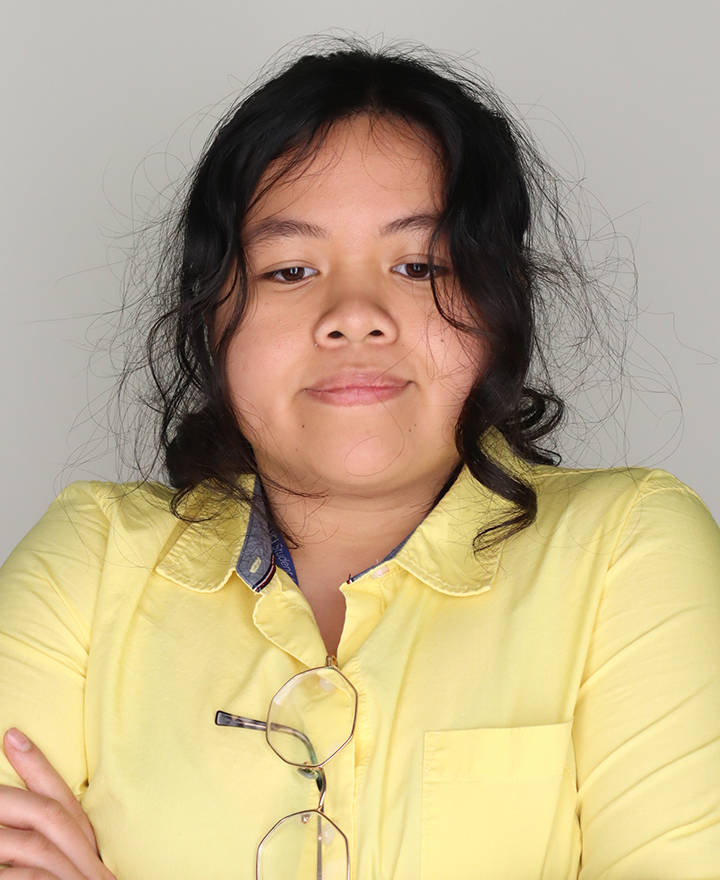 Ngoc Le has a distinctive approach to note-taking. Each page is carefully organized,
with capitalized section headers, emphasized phrases, and the occasional personal
observation tucked into the margins. If a lecture reminds her of a book she’s read,
a show she’s watched, or a game she’s played, she’ll jot it down. Her notes are more
than records of classroom content. They’re a reflection of her process, a moment of
insight and analysis, and an indication of how engaged she is with the material.
Ngoc Le has a distinctive approach to note-taking. Each page is carefully organized,
with capitalized section headers, emphasized phrases, and the occasional personal
observation tucked into the margins. If a lecture reminds her of a book she’s read,
a show she’s watched, or a game she’s played, she’ll jot it down. Her notes are more
than records of classroom content. They’re a reflection of her process, a moment of
insight and analysis, and an indication of how engaged she is with the material.
“I try to make the material fun,” she says. “If something reminds me of something, I write that down. I like when my notes become personal.”
This instinct to engage deeply with her course material has served her well. Le is completing her undergraduate degree in political science at UC Irvine in just two years, a timeline accelerated by enrollment in community college when she was in high school.
Her timeline may be short, but her academic record reflects a broad and intentional range of experiences. She’s a member of both the Campuswide Honors Collegium and the Political Science Honors Program, and currently serves as a peer mentor and chair of the Honors Social Committee, where she helps plan events and support newer students. Beyond the classroom, she’s worked as a research fellow with Ballotpedia, served as an English conversation facilitator with the International Center, and interned with the Academic Engagement office of Associated Students of University of California Irvine (ASUCI), where she helped connect students with faculty and alumni. In 2025, she received the Summer Program in Research and Leadership (SPIRL) Instructor’s Choice Award—an unexpected recognition for her energy and dedication to undergraduate research.
“I didn’t even know the award existed,” she says. “They only announced two awards, and then suddenly they gave a third. It was like a surprise gift. It meant a lot. It reminded me how much I love doing research.”
The research, though, is only part of what draws her in. Le has known since grade school that she wanted to teach. At first, she wanted to teach math. Then, during high school in Norco, (having arrived from Ho Chi Minh City at 13) she was exposed to a different kind of education. In her government and history classes, she listened as classmates reflected on social movements and public institutions. It was the first time she saw how personal stories could connect to political structures.
That shift in perspective changed everything.
“I came from a background where math and science were emphasized,” she says. “But hearing other students talk about their lived experiences, especially during the Black Lives Matter movement, made me curious. It helped me understand my own identity better, and I wanted to keep asking those questions.”
A turning point
When Le enrolled at UC Irvine, she followed her older sister, who had already introduced her to the campus. She remembers walking through Aldrich Park and peeking into buildings closed at the time.
“My sister told me, ‘You’ll be able to go inside if you get in,’” she says. “And I really wanted to.”
Le now moves easily through the university’s many academic spaces. But it was one classroom in particular that gave her the vocabulary for the kind of work she hopes to do in the future. In fall 2024, she enrolled in “Politics of Decolonization,” taught by political science assistant professor Constantine Manda. His course, which focused on anti-colonial movements and the perspectives often excluded from dominant historical narratives, became a turning point for her.
“There were so many people in that class from different backgrounds, and everyone brought their personal stories to the readings,” she says. “Even though our identities were different, we could connect through our experiences. It made me realize how powerful political science could be when it’s rooted in identity and history.”
Manda would later become Le’s faculty advisor for her senior thesis, a project that builds on the scholarship about African independence movements and the long-term effects of decolonization on democratic development.
“UC Irvine has been a great space for her, and she has maximized each and every opportunity that has come her way including, for instance, seeking funding and mentorship for her undergraduate research work,” says Manda. “She truly exemplifies the very best of our students!”
Her relationship with Manda, formed through two courses and now sustained through her honors thesis, has been an important source of mentorship and academic growth. Through their weekly meetings and thesis development, she is learning how to balance big questions with precise methods. This experience, she says, has only solidified her ambitions.
Manda sees that potential as well.
“Ms. Le is not only a student who achieves the highest grades but also has a great eye for interesting extensions of extant literatures that will make her a formidable academic social scientist after her doctoral training, which is her next milestone in her academic journey,” says Manda.
Building a life in academia
Le is now applying to Ph.D. programs in political science, where she hopes to study the intersection of comparative and American politics, with a regional focus on Africa and the United States. She’s particularly drawn to the relationship between institutions and identity—how each shapes the other—especially through the lens of race, ethnicity, and political behavior. Her work explores how social movements influence public attitudes and how those shifts reverberate through democratic systems. Her goal is to become a professor, a role she sees not just as a career, but as a deeply fulfilling way to engage with people and ideas.
“I always knew I wanted to work with young people and teaching at the college level feels right,” she says. “Students come in with some background knowledge, and we get to talk about complex issues, things that matter. I want to be in that space.”
She’s also drawn to the multidimensional nature of academic life. She has seen her professors involved in projects that extend far beyond the classroom.
“It’s not just teaching,” she says. “They’re doing real work. Some of them are involved with NATO, or work with policy centers, or help build programs for marginalized communities. It’s inspiring to see that kind of reach.”
Still, she understands that the path is not without its challenges. Le is clear-eyed about what lies ahead—everything from limited funding to the competitiveness of academia. But she also sees an opportunity to carve out a space of her own.
“I think that’s part of why I’m so involved now,” she says. “I know I only have two years here, so I’m trying to make the most of it—not just for my résumé, but to figure out who I want to be in this field.”
In just two years, she’s already begun to answer that question.
-Jill Kato for UC Irvine School of Social Sciences
pictured: Ngoc Le and the Campuswide Honors Collegium Social Committee with their CHCommunity Excellence award. Ngoc Le.