


Finding her why

Finding her why
- August 14, 2025
- Through UC Irvine’s Summer Program in Research and Leadership, psychology major Lily Paris Zahraii took her first steps into academic research and discovered much more along the way
-----
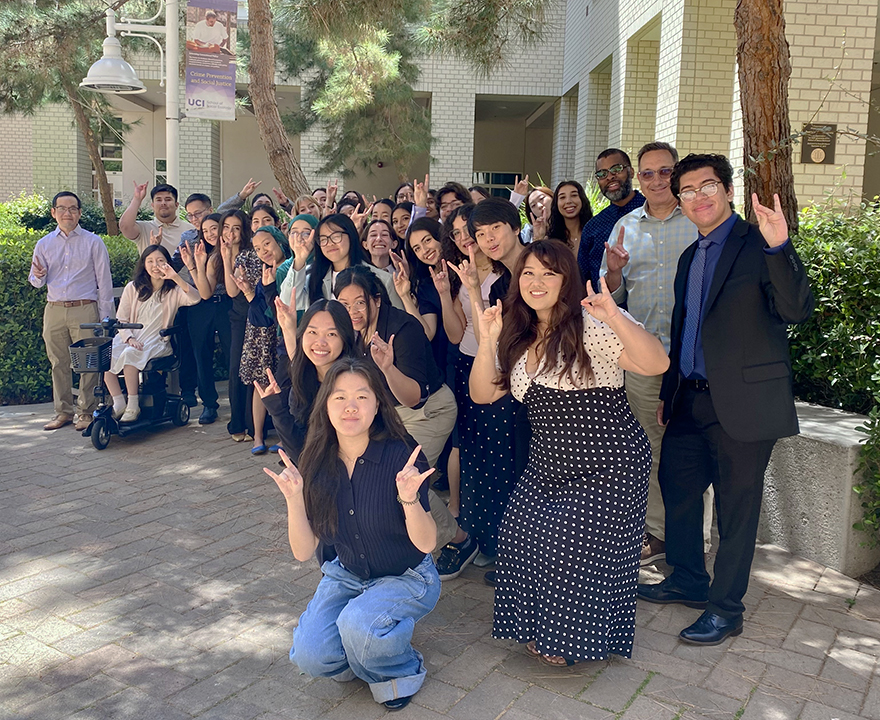 Lily Paris Zahraii has always been curious about how people think and behave.
“I’m deeply interested in how curiosity drives exploration and how open-ended thinking leads to discovery,” says the second-year psychology B.S. major and experimental psychology Ph.D. hopeful. She chose UC Irvine for its robust research reputation and emphases in her area. “UC Irvine has such excellent opportunities in research and an amazing psychology program. And I love how strong the communities are here; it makes the school seem so much smaller.”
She had been looking for opportunities to expand her experience when - while perusing the Social Sciences Academic Resource Center enewsletter - she discovered an announcement for the Summer Program in Research and Leadership, previously known as the Summer Academic Enrichment Program. The intensive, five-week on-campus program offered by the School of Social Sciences is designed to enhance the academic experience of undergraduate students.
“I knew that I wanted to pursue research in the future, but I honestly did not know where to start. Reading the program description, I thought it would be a good opportunity to understand the nature of research better and to challenge myself,” says Zahraii. “To this point, I hadn’t done academic research at this level, and I thought applying was a good starting point.”
She applied and was accepted as one of 30 social sciences undergraduates comprising the program’s 32nd annual summer cohort.
“SPIRL is the new name and iteration of SAEP, which has run for over three decades,” says Long Bui, UC Irvine global and international studies professor and SPIRL program director. “We have a new title, but our mission remains the same: to introduce students to research, leadership, and grad school, preparing them for public and professional life after UCI.”
Since beginning in June, the 2025 group has spent many hours together throughout the rigorous research experience and earned 8 units of academic credit toward their undergraduate degrees.
The curriculum, as in years past, has focused on strengthening analytical, speaking and research skills while providing an overall orientation to graduate education. Students come out of the more than month-long program better prepared to pursue graduate school, an honors thesis, the Undergraduate Research Opportunities Program (UROP) and other formalized research programs, says Bui. It also prepares participants for working with historically underserved communities through volunteerism, public advocacy and internships.
“SPIRL is the gateway program for most of our students,” says Bui who is also a program alumnus. “Almost all students have never done UROP, an honors thesis, study abroad or knew about grad school before they enter the program. After they complete it, most go on to take those opportunities.”
For her formal research project, Zahraii explored cognitive flexibility - the ability to adapt to change in various situations, which impacts cognitive processing.
“I was curious to see how this manifests and could be adapted,” she says. “I read lots of literature and conducted a mixed-methods study looking at factors of mentor support, community involvement and emotional regulation, seeing their association with cognitive flexibility.”
She presented her findings at the program’s closing ceremony on July 30. Others in her cohort shared their work on topics ranging from the sociohealth impacts of AI to violence in Nigeria.
“Seeing everyone’s projects come together was one of my favorite parts. I loved seeing how unique everyone’s research topics were, and it was especially interesting to see the development process,” she says.
In addition to learning how to conduct research, Zahraii also appreciated the unexpected outcomes she and her fellow SPIRL class discovered - from meaningful connections to a stronger sense of purpose in pursuing graduate study.
“I learned a lot about hidden curriculum, more than anything I could have found through my own research,” she says. “There was also an emphasis on finding our purpose; what drove us to this path, and why. I think that was particularly helpful; once that foundation was built, things like grad school applications, interviews, leadership and passion projects were a byproduct.”
Peer networking was also an essential part of the experience.
“Connecting with research-focused peers and seeing how they approached their work expanded my own thinking,” she says. “The conversations we had challenged me and helped me grow in ways I didn’t expect.”
“I came into this program hoping to learn how to do research and challenge myself,” she adds. “It exceeded every expectation I had.”
-Heather Ashbach, UC Irvine School of Social Sciences
-photos by Luis Fonseca, UC Irvine School of Social Sciences
-----
Would you like to get more involved with the social sciences? Email us at communications@socsci.uci.edu to connect.
Related News Items