


Beyond the syllabus
 Jennifer Cabrera didn’t exactly know what the Lauds & Laurels Awards were when she
was told she’d been named UC Irvine’s Outstanding Graduate Student for 2025.
Jennifer Cabrera didn’t exactly know what the Lauds & Laurels Awards were when she
was told she’d been named UC Irvine’s Outstanding Graduate Student for 2025.
“I remember thinking, how did I end up in this incredible group of awardees?” she says, laughing with genuine bewilderment.
But spend any time learning about her work—her research, her mentorship, her expansive community-building—and the real question becomes how she ever thought she wouldn’t be.
The Lauds & Laurels recognition, awarded annually by the UC Irvine Alumni Association and its board of directors, is one of the university’s oldest honors. Since 1971, the awards have celebrated members of the UC Irvine community who embody the university’s values through service, professional excellence, and personal achievement. Cabrera’s name now joins a list of more than 900 honorees who have left a lasting mark on the campus and beyond.
“It brought a huge smile to my face when I heard that she was selected as the recipient of the Lauds and Laurels Outstanding Graduate Student Award,” says Glenda Flores, Cabrera’s dissertation advisor and professor and chair of Chicano/Latino studies. “I like to describe Jennifer as a jill-of-all-trades—or a Jennifer-of-all-trades. I have been incredibly impressed with her ability to think outside of the box in her research approach and to adapt to different academic spaces.”
Her dissertation explores how Latina doctoral students use social media to navigate the hidden curriculum of graduate school— those unwritten rules and tacit expectations rarely included in formal training. She is also the founder of Academic Latina, an Instagram-based resource and support hub with more than 30,000 followers. Beyond her research and public scholarship, Cabrera has taught in all three tiers of California’s higher education system, mentored dozens of students at UC Irvine, and developed programming to help underrepresented undergraduates pursue advanced degrees.
“Jennifer is a go-getter,” Flores adds. “She rises to the occasion and puts herself out there. What I like most about her is that she is undeterred and finds solutions to problems.”
Modeling community
Cabrera was raised in Boyle Heights, a historically Latino neighborhood just east of downtown Los Angeles. Her parents have lived in the same apartment complex for more than 30 years.
“Everyone knew each other back then and we still do,” she says.
At the center of that tightly woven community was her maternal grandmother: a seamstress, a tamale vendor, and “a pillar of the community.” She welcomed relatives who had just arrived from Mexico and opened her home to anyone in need of a place to land.
Her grandmother also cared for Cabrera while her parents worked—modeling, each day, what it looked like to show up for others not out of obligation, but out of love.
“She’s a big reason why I do the mentorship I do today,” Cabrera says.
She sees her own mentorship as a continuation of the work her grandmother modeled. Where her grandmother helped family members navigate a new country, she is helping students navigate a new institution.
 Cabrera’s initial plan was to become a preschool teacher. She earned her undergraduate
degree in child and adolescent development at Cal State Northridge. But over time,
it was the undergraduates—not the toddlers—who captivated her attention.
Cabrera’s initial plan was to become a preschool teacher. She earned her undergraduate
degree in child and adolescent development at Cal State Northridge. But over time,
it was the undergraduates—not the toddlers—who captivated her attention.
“I liked helping undergraduate students find direction,” she says. “That’s when I realized I wanted to be a professor.”
She went on to earn a master’s degree in education at UC Irvine before shifting to sociology for her Ph.D. “I was taking so many classes in sociology and Chicano/Latino studies to support my dissertation that I eventually realized I belonged in that department,” she says. “It aligned better with my research.”
The hidden curriculum
Cabrera’s research centers on what’s often left out of the syllabus. The “hidden curriculum” refers to the tacit knowledge students are expected to have but are rarely taught.
“Everyone says, ‘Apply for funding,’ but no one tells you where to look or how to write a proposal,” she explains. “There are so many things—how to navigate conferences, how to ask for mentorship, how to recover from rejection—that aren’t part of any syllabus.”
To understand how Latina doctoral students are filling those gaps, Cabrera interviewed members of a private Facebook group where students across the country share experiences, advice, and solidarity. That project, originally part of her master’s work, became the foundation for her dissertation—and eventually inspired her to create Academic Latina, a platform she launched in 2020.
What began as a way to share funding tips and fellowship resources quickly evolved into something deeper. She started writing about her own journey—what she was working on, how she managed stress, how she processed burnout and rejection. The account grew, and with it, a community.
“It’s not just information,” she says. “It’s representation. It’s validation. Students see someone like them doing this work and think, ‘Okay, maybe I can do this too.’”
For students with few mentors in their programs, Cabrera’s posts offer more than advice. They offer belonging.
Making space
Cabrera’s mentoring extends beyond her digital platform. At UC Irvine, she’s served as a mentor through the Competitive Edge program and the Summer Undergraduate Research Fellowship (SURF) and has led the Graduate Access Preparation Program for multiple years—helping underrepresented undergraduates prepare for graduate school through a two-quarter course she helped design.
But one moment stands out: the opportunity to teach her own course in Chicano/Latino studies.
“It was an honor,” she says plainly. “Most of my students were Latine and they told me they had never seen their lives reflected in the curriculum before.”
That reflection went beyond content. It extended to who stood at the front of the room as well.
“One student said, ‘I’ve never felt so seen in a syllabus.’ That’s going to stay with me,” Cabrera says.
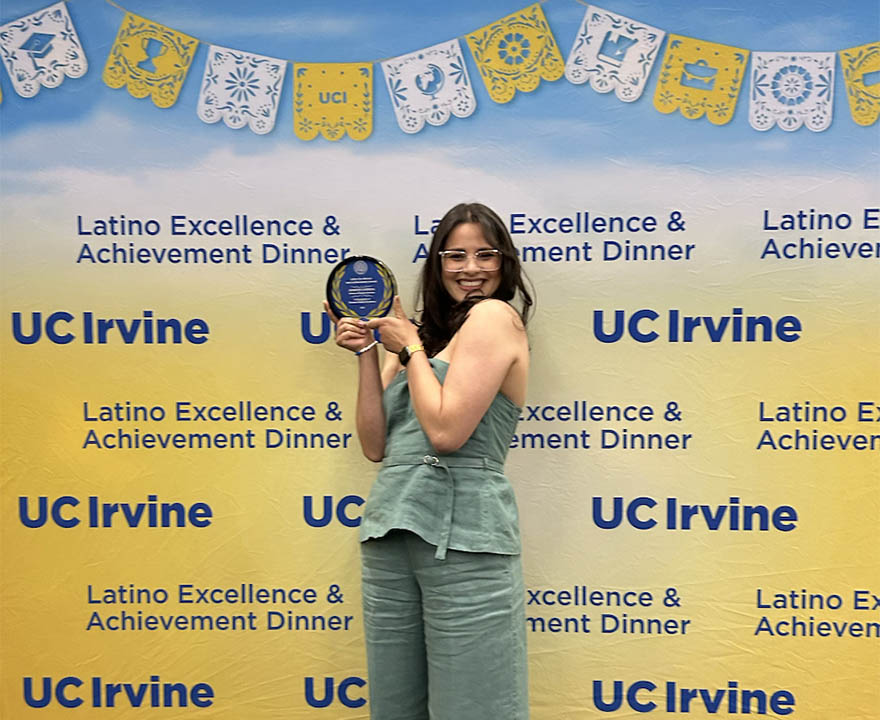
Earlier this year, she was also honored with a Graduate Student Excellence Award at UC Irvine’s Latine Excellence and Achievement Dinner and brought her mother as her guest.
“She always says she’s living her dream of being a teacher through me,” Cabrera says. “Watching her at the university, meeting everyone, hearing about what I do—I could see how proud she was. I think it was a really meaningful moment for both of us.”
Legacy in practice
Now in the final stages of her Ph.D., Cabrera is drafting her second dissertation chapter and preparing to present her research at the American Sociological Association’s annual meeting in Chicago. She’s also entering the faculty job market, with hopes of staying in Southern California to stay close to family, and close to the communities that shaped her.
She’s focused now on completing her research and mentoring as many students as she can. Her grandmother stitched together a community. Cabrera is doing something similar—just with different tools.
-Jill Kato for UCI Social Sciences
-pictured: Jennifer Cabrera. LEAD award dinner. First day of teaching.