


Creating community-centered climate solutions
 Scalable solutions to the mounting global climate crisis require a collaborative approach.
A new UC Irvine-Santa Ana partnership is bringing the classroom into the community,
linking researchers and students with local leaders and residents to transform polluted
vacant lots into multifunctional green spaces with health, environmental and community
benefits. When completed, says UC Irvine anthropology professor and EcoGovLab director Kim Fortun, the multi-year project can serve as a statewide roadmap for
creating equity-centered climate solutions through model campus-community partnerships.
“Across California, many urban neighborhoods carry a double burden: high pollution levels and limited access to parks, shade and cooling green spaces,” she says.
This issue is particularly acute in Santa Ana’s Cornerstone Neighborhood where contamination from nearby metal plating operations have rendered many properties that might otherwise be developed into green spaces and walkways unusable. And, sadly, Santa Ana is hardly an outlier. California Senate Bill 535 has designated 2,310 census tracts as “disadvantaged communities” (DACs) due to combined pollution burdens and socioeconomic vulnerabilities. In Santa Ana alone, over half of the city’s neighborhoods are DACs.
“We call this a brown-green paradox: few homes have air conditioning or access to cooling, green spaces which are urgently needed but only deeply contaminated properties are available,” says Fortun. “Our project aims to address this challenge through development of specific community-engaged, affordable and politically feasible solutions that can then be replicated for statewide impact.”
She’s co-leading the Orange County effort alongside Christopher Olivares, UC Irvine civil and environmental engineering assistant professor and Water-Energy Nexus Center associate director, a team of graduate and undergraduate researchers, and community partners from the City of Santa Ana Cornerstone Neighborhood Association.
The project draws upon strengths in social sciences and engineering, connecting expertise in environmental governance, community-engaged research and urban planning systems with specialized knowledge in soil and water contamination, pollutant monitoring and remediation. It also has a strong educational through-line, bringing campus and community participants together to tackle real-world challenges through hands-on learning.
“Engineering and social science students will have complementary roles in the research and learn from each other, regularly interacting with each other and the community members and government agency staff,” Olivares says. “Community members will also be essential in research planning, sampling and data collection, and translation of findings into actionable proposals that serve the community’s needs.”
The work will also provide the foundation for a potential undergraduate engineering-social science climate government concentration at UCI, grounded in the essential role interdisciplinary approaches play in developing effective climate change solutions.
Working together, the team will gain a baseline understanding of the Santa Ana Cornerstone community’s contamination history and climate change impacts through GIS and database resources. They’ll build on previous research done by the EcoGovLab which mapped the location of regulated facilities and their proximity to schools as well as relevant city zoning requirements. Ongoing interviews with key stakeholders and officials will help illuminate environmental governance opportunities of various plans, land trusts and related mechanisms as well as the regulatory environment.
The group will focus on several county-owned properties that the Cornerstone Neighborhood Association has already identified for their potential to provide maximum cooling opportunities and green pathways connecting homes and schools outside of high-traffic areas.
Soil sampling and laboratory analysis will be used to gauge existing levels and types of pollutants, making use of the Olivares Lab mass spectrometer which can measure PFAS, often called forever chemicals, following the most recent standards at very low levels. Undergraduates will have an opportunity to learn critical sampling and analytical methods under the direction of graduate researchers skilled in this practice, while external commercial lab testing will provide levels of additional pollutants to understand the pollution profile.
Throughout the process, social sciences and engineering students and faculty will meet regularly with community partners at field site visits and planning meetings to discuss findings and processes. Together, they’ll map governance mechanisms and create best practices for integrating findings into formal remediation options.
Once contamination levels are known, the interdisciplinary campus-community team will work together to create a specific action plan that, when implemented, will help turn the community’s polluted, vacant lots into usable green spaces.
“This project hopes to offer a replicable model for communities across California facing the same tension between emerging PFAS and legacy contamination and the need for urban greening,” says Fortun. “The deliverables, including assessments of the suitability of different remediation approaches and governance guides, will serve city planners, land trusts, and community organizations seeking to reclaim polluted land as public spaces that help communities thrive.”
Importantly, she explains, the project is action-oriented while addressing fundamental research questions.
“In environmental engineering, the work will advance basic understanding of ways PFAS chemicals interact with other contaminants produced by metal plating - including hexavalent chromium, the contaminant made famous in the blockbuster film Erin Brockovich,” Fortun says. “Social science research will advance understanding of knowledge-to-governance pathways in environmental governance.”
“UCI’s earlier air chemistry research that led to the Montreal Protocol to protect stratospheric ozone is a well-studied, exemplary case of knowledge-to-environmental governance,” she adds. “With this new work, we hope to demonstrate knowledge-to governance yet again, in both theory and practice.”
—
“Addressing the Brown-Green Paradox in Disadvantaged Communities: Bringing Legacy Contamination into Climate Governance” is one of five projects in the UC Irvine Climate Collaboration’s second cohort of funded works. Launched last year, the UC Irvine Climate Collaboration addresses the growing stresses and disruptions in California brought on by increasing heat, extreme weather, drought and other climate concerns. Tapping into more than a dozen academic schools on campus with disciplinary strengths in climate and sustainability, the Climate Collaboration enables problem-focused projects where external partners with front-line management expertise work alongside UC Irvine’s leading research teams.
-Heather Ashbach, UC Irvine School of Social Sciences
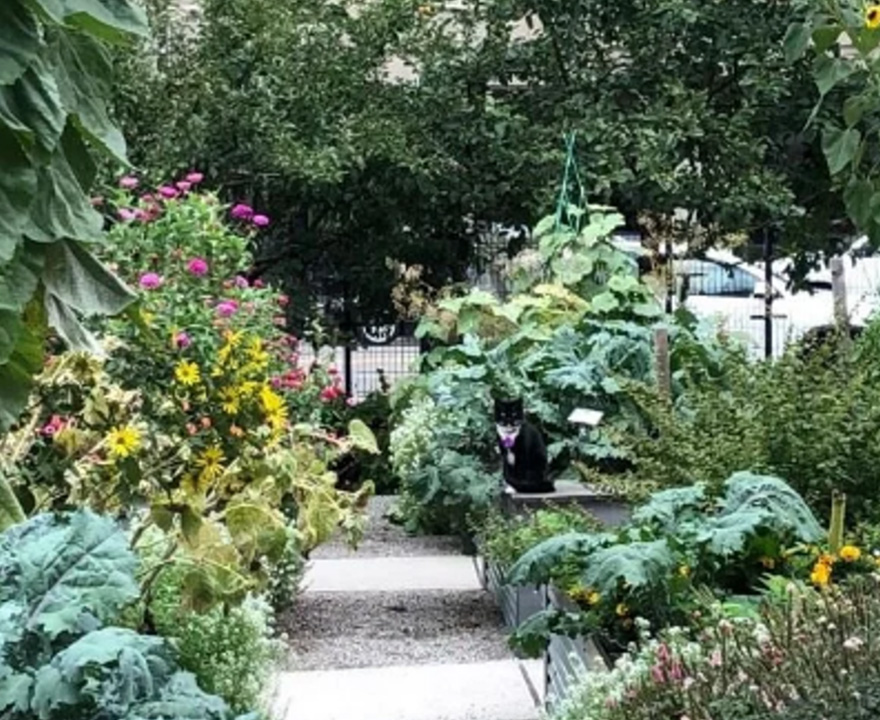
-pictured top to bottom: A city walkway showcasing a successful conversion of contaminated
properties into green space. Orange County-owned vacant lots adjacent to Cornerstone
Village that community members would like to convert into a similar green walkway
to two schools (Kennedy Elementary and Century High School); currently students walk
to school along heavily trafficked roads.