


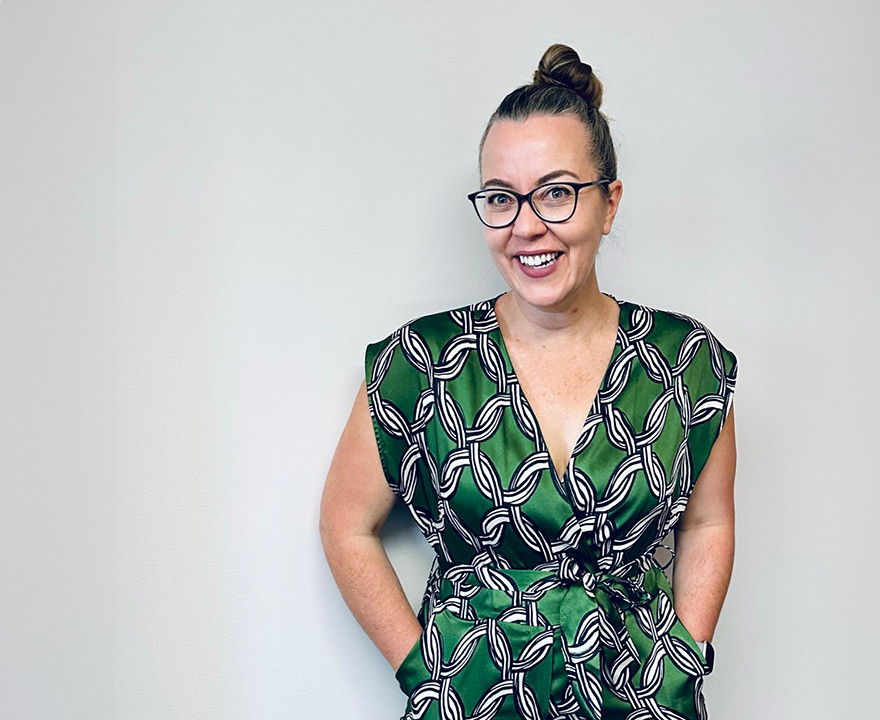
Lightening the mental load
Everyone carries an invisible mental load, not just parents. Checking in on a friend in the midst of a breakup, planning dinner, dreaming about the future – they’re all using up your brain’s bandwidth.
Internationally renowned sociologist and UC Irvine alum Leah Ruppanner, M.A. ’06 Ph.D. ’09 wants to help people to understand, measure and manage the emotional thinking that’s zapping their energy. She’s turned years of research on gender, work and family into a practical guide for the exhausted and overwhelmed – and readers are eating it up. Her first book for general audiences, Drained: Reduce Your Mental Load to Do Less and Be More (Penguin 2026) has been internationally distributed, and is now being translated into Spanish.
“When you’re doomscrolling on TikTok or Instagram, you’re burning through your mental load, and the result is that you feel immobilized,” Ruppanner says. “My concept can help you understand why this is a waste, and how to move toward action.”
As a professor of sociology at the University of Melbourne, Australia, and founding director of The Future of Work Lab and the Gender Equity Initiative, Ruppanner studies “gender at the intersection of everything,” including technology, politics, the workplace and homelife. She traces many elements of her successful international career as a scholar, author and podcaster back to her time as a graduate student at UC Irvine, where she earned her master’s in demography and population studies in 2006 and her doctorate in sociology in 2009.
“It’s really about the people,” she says. “The people I was with at UC Irvine showed me a wider blueprint of pathways that I could take.”
‘The result of perseverance’
As an undergraduate at the University of California, Santa Barbara, Ruppanner took several social sciences classes and found sociology was “the lens through which I could see most clearly.” At a dinner with faculty one night, she told them, “I think I want to be you,” and began her pursuit of an academic career.
Arriving at UC Irvine, Ruppanner knew she wanted to study gender – but she soon discovered that topic is too broad to tackle in a lifetime, let alone one graduate program. Her advisors Judith Treas, Distinguished Professor emerita, and Matt Huffman, professor and associate dean of student programs, helped her refine her scope into more manageable pieces.
Ruppanner started contributing to Treas’ research on the division of household labor and, along the way, she learned much more than how to run a study. Treas connected her with researchers and journalists who Ruppanner still works with today.
“One of the gifts from UC Irvine was not only getting to work with faculty who are leaders in the field, but who also understand the value of mentorship, who pulled me up on my journey and used their resources to help me give opportunities to meet people who I couldn't have otherwise at my age and stage,” Ruppaner says. “And it’s still bringing me value.”
The master’s degree that Ruppanner earned on the way to her doctorate helped make her more marketable, and the cross-national aspect of Treas’ research gave Ruppanner access to positions in the international academic job market. Still, graduating in 2009 at the peak of the Great Recession tested her commitment to academia. She applied for hundreds of jobs, she says, before landing one.
“I want people to know that the story you’re seeing today is the result of perseverance. I had to do soul searching, I had to stay persistent,” she says. “If you feel like you’re getting those knocks, it doesn’t mean you’re not on the right path. This journey is hard.”
Ruppanner eventually took a tenure-track position at the University of Melbourne, where she turned her research focus back to the U.S. Collaborating with an international team, Ruppanner examined state policies affecting working mothers – comparing states of the union in a way she had previously compared European countries. Her book Motherlands: How States Push Mothers Out of Employment, was published in 2020, on the eve of the COVID-19 pandemic.
As the pandemic blurred lines between work and home life, Ruppanner teamed up with Senior Researcher for Equity at the U.S. Census Bureau Liana Christin Landivar, M.A. ’04, Ph.D. ’07, whom she knew from graduate school. The duo mapped the pandemic responses state by state, measuring how policies like school closures impacted women’s employment – work that would ultimately influence the president’s economic policy in 2023.
Reaching different audiences
That’s exactly the kind of impact Ruppanner aspires to make. She’s been named Australia’s top sociologist and top gender studies scholar, but what she really wants is for sociology research to benefit people’s lives. That seed, planted by a sociology professor when Ruppanner was still a graduate student at UC Irvine, grew as she established her own body of research.
“Sociology’s ideas are incredibly sticky and valuable, they can change the way people see the world and see themselves. In a moment when social science is under attack, we need to be out in the world talking about it,” she says. “If we’re not doing the work to connect to people, if we just publish in isolation, then we’re dead in the water.”
So she started writing for The Conversation in Australia, and felt the thrill of her ideas reaching millions of people. Plunging further into the cultural zeitgeist, she launched her own podcast, Miss Perceived, in which she declares, “I’ve made it my life’s mission to take down every ridiculous gender myth out there – like do pretty people get paid more or are women better multitaskers?” For Ruppanner, podcasting allows her to be more “3 dimensional” as a human and not only a scholar – but it’s also served as a sort of feedback loop for her research.
“What I’m learning from the podcast is how to talk to different audiences in a different way. It’s more of a heart-first connection than a head-first connection, and that’s almost like a focus group for a research project,” she says. “Academics tend to speak through data, but we need a bridge to them through the narrative heart of the story first.”
“I’ve been trying to build an ecosystem of research translation, and podcasting helps me do that,” she adds.
Sticky ideas
As a founding director of the Future of Work Lab and the Gender Equity Initiative at the University of Melbourne, Ruppanner continues pursuing research that improves lives. Working with computer science, economics and business scholars in the lab, she aims to ensure work is equitable and inclusive, even as it’s reshaped by powerful emerging forces like artificial intelligence. One of her ongoing research projects deals with reskilling for the future workforce.
In 2023, Ruppanner received a $1.2 million fellowship from the Australian Research Council to take a deep dive on the mental load – an increasingly sticky idea that women, especially, are drowning in invisible labor.
Talking to the BBC, Ruppanner explained the motivation behind the project: “I've studied gender, work, family, housework and domestic divisions for decades. And even though we kept seeing that men were doing more at home – we kept seeing this movement towards progress – there was this thing that just wasn't working, this thing that we weren't capturing, that we weren't measuring. That thing is the mental load.”
Defined as “thinking work with emotional weight,” the mental load comes in eight distinct varieties, according to Ruppanner, ranging from everyday planning and tasks to cultivating one’s dreams and ambitions. She also spells out seven stages of the mental load, from identifying and remembering the problem to executing and monitoring the solution. All of that invisible labor can lead to burnout. Figuring out where you’re spending mental energy can help prevent that.
In Drained and on her website LightenLab, Ruppanner offers a worksheet to help account for the mental load you’re carrying. From there, individuals or couples can unpack, redistribute, and reload in a way that makes sense and, hopefully, is more equitable. Because the mental load shifts over the course of a day, a week, or a year, Ruppanner suggests monitoring it regularly – just like taking blood pressure or counting your daily steps.
Ruppanner would love to see her ideas catch on the same way wearable trackers have, helping people understand and ultimately lighten their mental load – and proving that sociology can make your life better.
– Christine Byrd for UC Irvine School of Social Sciences