


Research in action
Research in action
- October 1, 2026
- UC Irvine global & international studies associate professor Tiara Na’puti is co-leading a $2.295m project advancing Indigenous research, practices to improve planetary health
-----
 Generating global health knowledge and policy through Indigenous-led research and
practices has been the focus of a three-year, $2.295 million project co-led by Tiara
R. Na’puti, UC Irvine global & international studies associate professor. Funded by
a Fall 2023 Project Grant from the Canadian Institutes of Health Research (CIHR),
Canada’s primary federal funding agency for health research, the research team has
received an extended award through 2027 to further their work.
Generating global health knowledge and policy through Indigenous-led research and
practices has been the focus of a three-year, $2.295 million project co-led by Tiara
R. Na’puti, UC Irvine global & international studies associate professor. Funded by
a Fall 2023 Project Grant from the Canadian Institutes of Health Research (CIHR),
Canada’s primary federal funding agency for health research, the research team has
received an extended award through 2027 to further their work.
“The greatest threats to human health and the health of the planet are the trifecta of biodiversity loss, climate change, and pollution,” says Na’puti. “Our project begins with Indigenous Peoples who are addressing this crisis by sustaining knowledge systems and regenerative practices; stewarding biodiversity; and activism that is stopping or delaying greenhouse gas pollution.”
As a co-principal investigator, Na’puti, alongside a multidisciplinary team of Indigenous scholars, will continue examining the value of and protocol for sharing place-based evidence of Indigenous-led projects that aim to improve planetary health.
Their work is divided into five case studies, or islands, with Na’puti leading the focus on community-based health practices to address U.S. military pollution and climate change in the Mariana Islands. The other four focus on traditional land-based leadership-development practices in Hawai’i; Indigenous farming, forestry and fishing practices for sustainable business in Aotearoa; restoring cedar cultivation and carving in the Pacific Northwest; and the songs, dances, and lessons derived from the Buffalo on the Great Plains.
Na’puti and her collaborators anticipate that these “islands” will show Indigenous-led resurgence can improve planetary and human health within their geographical and cultural contexts. The team is currently creating a systems-change model that connects individual projects into an archipelago of sharing and transformation.
“This CIHR project grant is especially important; given the timeliness of the hypermilitarization of Oceania and the historic Pentagon investments in Micronesia and the Mariana Islands, the impact of militarization on the health of the environment cannot be understated,” Na’puti says. She recently shared her work on the archipelagos research collective with the Indigenous Planetary Health podcast, episode 46: “The Mariana Islands: A three-part series.” Listen in to learn more.
The full project is led by Hōkūlani Aikau, a professor in the School of Indigenous Governance at the University of Victoria. “We anticipate that our research-, creation-, and action-oriented processes and an Indigenous-guided evaluation framework can help to create the kind of momentum and impact that is needed to secure our collective futures,” Aikau says.
Additional principal investigators for the islands include Heather E. Castleden and Carey Newman (Hayalthkin’geme/Kwakwa̱ka̱’wakw) with the University of Victoria; and Melissa N. Quesnelle (Nimototo Kanai/Blood Tribe of the Blackfoot Confederacy), and Lisa te Heuheu (Ngāpuhi and Ngati Raukawa tribes/Aotearoa).
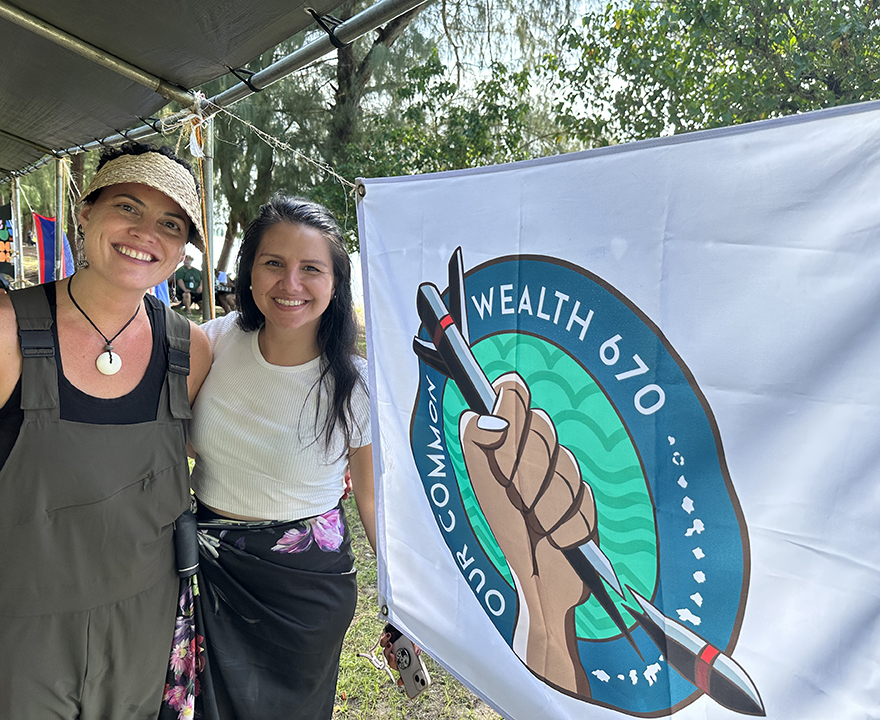
Na’puti’s research funding - $253,000 in total over the three years – has been supported via CIHR subawards from the University of Victoria and Our Common Wealth 670, one of the project’s key community partners based in the Northern Mariana Islands.
---
Na’puti joined the UCI faculty in 2022 following a one-year Mellon/ACLS Scholars and Society Fellowship where she worked with communities in Guåhan on issues of sovereignty and climate change. She earned her M.A. and Ph.D. in communication studies at The University of Texas at Austin. As an Indigenous Chamoru (familian Robat & Kaderon), she is committed to understanding how Indigenous communities address issues of political status as well as militarization and climate change. Her work on issues of militarism and sovereignty in the Pacific Islands has been published in American Quarterly, Communication and Critical/Cultural Studies, Quarterly Journal of Speech, and Feminist Studies. Her public scholarship about militarism in U.S. territories has also appeared in venues such as In These Times and Common Dreams. She has testified at the United Nations Special Political and Decolonization Committee (4th Committee) on the political status of Guåhan.
---
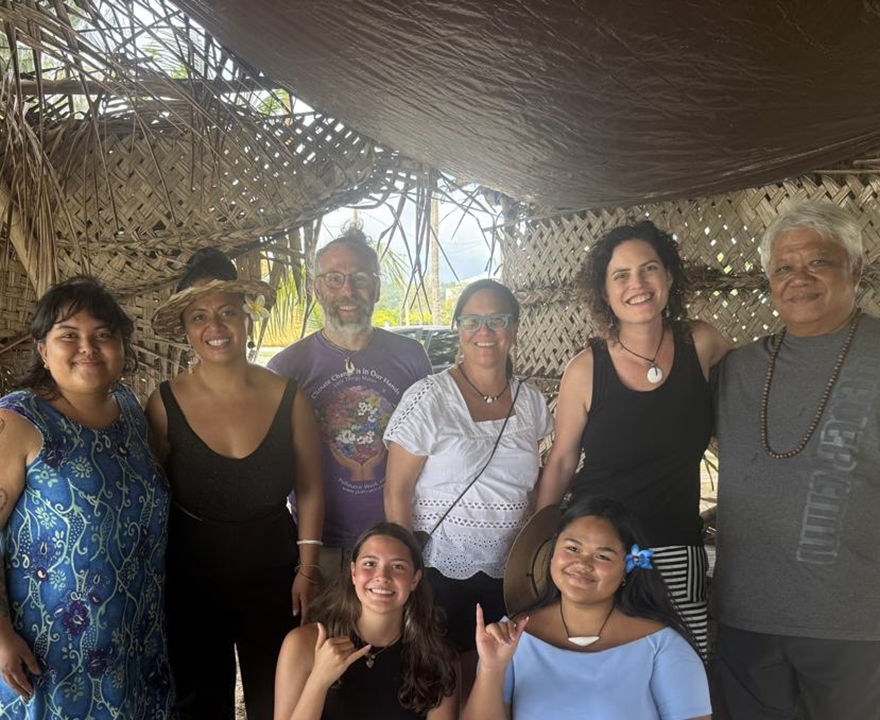
pictured: Outside the canoe house in Susupe village, Tiara Na’puti (back row, second from right) with members of her project partner Our Common Wealth 670 and Saipan residents. In July 2025, Na’puti led a week-long research visit, bringing co-PI Hōkūlani Aikau, University of Victoria (back row, fourth from left) to the islands of Guåhan, Saipan, and Tinian. Na’puti with Theresa "Isa" Arriola, founding board member of Our Common Wealth 670.
-----
Would you like to get more involved with the social sciences? Email us at communications@socsci.uci.edu to connect.
Related News Items
- Careet RightNa'puti receives funding for Indigenous research and connections with the canoe at UCI
- Careet RightSocial sciences research at risk
- Careet RightIndigenous Peoples' Day: UCI Actions Toward Reciprocity
- Careet RightReimagining resilient agri-food supply chains
- Careet RightNa'puti receives grant to collect missing data and collaborate with Native Hawaiian and Pacific Islander communities