


Game Theory, Machine Learning, and Production in Sports: The Fair-Credit Baseball Statistics
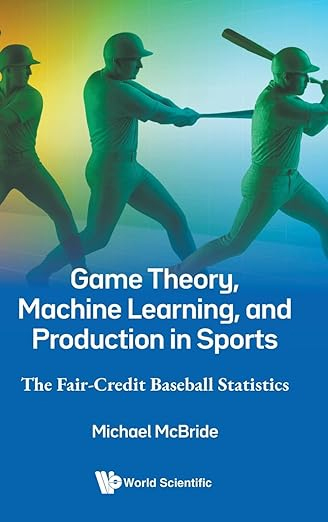 UC Irvine’s Michael McBride brings together his passions as an economist and longtime baseball enthusiast - both
in the stands and on the field as a former youth coach - in his new book, Game Theory, Machine Learning, and Production in Sports: The Fair-Credit Baseball
Statistics (World Scientific). The work provides a deep dive into the professor’s application
of a novel statistical system for fairly distributing credit in team sports. Below,
he shares the story behind his “aha” moment, what traditional stats overlook, and
how his framework could reshape not only baseball analytics but fairness in team-based
efforts far beyond the field.
UC Irvine’s Michael McBride brings together his passions as an economist and longtime baseball enthusiast - both
in the stands and on the field as a former youth coach - in his new book, Game Theory, Machine Learning, and Production in Sports: The Fair-Credit Baseball
Statistics (World Scientific). The work provides a deep dive into the professor’s application
of a novel statistical system for fairly distributing credit in team sports. Below,
he shares the story behind his “aha” moment, what traditional stats overlook, and
how his framework could reshape not only baseball analytics but fairness in team-based
efforts far beyond the field.
Q: Your book tackles a fundamental and long-standing challenge in team sports: fairly measuring individual performance when success depends on collective effort. What motivated you to take on this problem, and why now?
A: The book really began with a return to my childhood love of baseball. When I started coaching my children in baseball and softball in the 2010s, I dove into the latest research to understand modern baseball analytics. I was surprised and fascinated by the explosion of new statistics, each designed to solve specific problems in the measurement of player performance and skill.
A key talking point in the baseball community is that the traditional stats have many shortcomings, one of them being that they distribute credit for runs in an unfair way. Then, one day while thinking about this problem, I had an 'aha' moment—I realized I could apply the Shapley Value from game theory to solve this exact issue. It turned out to be a pretty difficult problem that took me years to solve and implement, but that initial realization was proven 100% correct.
What made this particularly exciting was that I found myself in a unique position. While many people know baseball inside and out, very few understand game theory. Conversely, many economists know game theory but aren't deeply familiar with baseball. I happened to be one of the rare people who understood both well enough to find this solution. I could bring a completely different conceptual framework that had never been applied to baseball before. That knowledge proved to be very motivating.
Q: You propose a novel statistical framework—Shapley Run Credits (SRC) and Offensive Shapley Win Credits (OSWC)—grounded in coalitional game theory and machine learning. Can you walk us through what question you were trying to answer, and what your process revealed that traditional baseball stats have missed?
A: The fundamental question that the SRC stat is trying to answer is this: When a team scores a run in baseball or softball, how much credit should each individual player receive for that run? Traditional stats like runs batted in (RBI) and runs scored only tell part of the story; it’s like they give full credit to just the person who crosses the finish line in a relay race, ignoring everyone who passed the baton.
My research revealed just how bad of a job these traditional statistics do at accounting for the collaborative nature of scoring. The SRC stat solves this by treating each scoring play like a team project and fairly dividing credit among everyone who contributed. The math considers all possible ways the scoring could have happened and calculates each player's average contribution across those scenarios. My OSWC stat does a similar thing except it fairly divides credit for helping one’s team outscore the opponent. So it awards credit for helping one’s team win a game.
What's fascinating is that this approach sometimes reveals the opposite of what other stats suggest. I found cases where a player had zero or even negative value according to other metrics but actually contributed positively to real runs scored. Although over the course of a long season the best players will generally accumulate high values by pretty much all stats, for any particular game the differences can be significant. So, these new stats really provide a more accurate picture of what happens in a game.
Q: Why is fairness in credit assignment such an important issue—not just in baseball, but in broader team-based contexts like business or law?
A: Fairness matters in almost everything—from paychecks to promotions to legal settlements. In any team effort, whether it's a business project, a legal case, or whatever, people want their contributions to be recognized in a fair and accurate way. When credit isn't assigned properly, it creates resentment, reduces motivation, and can lead to serious disputes.
The Shapley Value formula that I applied to solve baseball's credit problem is already used in economics, law, and business settings to fairly divide everything from profits to costs to blame. What's fascinating is that my research revealed that these same fairness principles can be applied to sports statistics, too. Baseball just happened to be another great application because every play is recorded, and the collaborative nature of scoring runs mirrors so many team situations beyond sports.
Q: By integrating game theory, machine learning, and over 100 years of baseball data, your work offers both technical rigor and real-world application. What do you see as the most exciting or surprising implications of this research for analysts, players, or even fans?
A: What excites me most is that this research finally gives us the tools to settle some of baseball's oldest debates with theoretically-grounded, mathematical precision. For analysts, we can now definitively answer questions like 'Who really deserves credit for that championship run?' using rigorous fairness principles rather than gut feelings.
For players, especially at youth levels, this could be transformative. Imagine a young player who doesn't get many RBIs but consistently moves runners into scoring position—traditional stats ignore their contributions, but my stats recognize and reward that value. This could help coaches identify and encourage players whose contributions have gone unrecognized.
My research also found that some of our most celebrated performances in baseball history might not be what we thought they were, while some overlooked contributions were actually more valuable than anyone realized. These new stats essentially rewrite the narrative of some of baseball's greatest moments. This opens up entirely new ways for fans to appreciate the game.
Q: As someone who bridges academic theory and real-world sports analytics, what actions or next steps do you hope readers—whether they’re researchers, analysts, or passionate fans—will take after engaging with your work?
A: I hope this work sparks action on multiple fronts. In current research I am using the Shapley Value to create new pitching statistics for baseball, and I am working with a co-author to adapt the ideas to the sport of cricket. I'd love to see this methodology applied to even more sports—like basketball or soccer.
Analysts and teams can use my stats in many ways, one of them being the creation of better performance-based contracts. Youth coaches especially could use this to identify and encourage players whose contributions have been invisible under traditional stats. Instead of just rewarding the home-run hitters, we could recognize the players who consistently advance runners and create scoring opportunities. Fans, too, can use these stats to identify and appreciate unsung heroes.
Beyond baseball, I hope this work inspires people to think more critically about fairness in all team settings—whether that's workplace projects, legal cases, or any collaborative effort. The fairness principles that underlie my baseball stats can help us to build more equitable systems beyond sports. Sometimes solving one specific problem opens doors to solving much bigger ones.
To learn more about McBride’s work, visit the Fair-Credit Baseball website. This research was generously supported by Steve Borowski. Steve was a UCI baseball player and pitcher, an economics alumnus (’79), founding member and past chair of the School of Social Sciences Board of Councilors, member of the Dean’s Leadership Society, UCI Foundation trustee, and lifelong fan of the game.